
Over the past several weeks, Israel has ramped up its encroachments on the al-Aqsa Mosque compound in Jerusalem. Just last week 200 Israeli activists invaded the compound, raising the Israeli flag, singing the Israeli national anthem, and reciting Talmudic prayers. Also last week, a bill advanced past a key hurdle in the Knesset that would allow Israel to restrict the call to prayer from al-Aqsa and other mosques. These developments come amid reporting that the US and Israel are trying to strip Jordan of control over the affairs of al-Aqsa.
Here is an excerpt from Najwan Darwish’s poem “Jerusalem,” translated into English by Kareem James Abu-Zeid.
The murdered hum their poems on the hills
and the rebels reproach the tellers of their stories
while I leave the sea behind and come back
to you, come back
by this small river that flows in your despair
I hear the reciters of the Quran and the shrouders of corpses
I hear the dust of the condolers
I am not yet thirty, but you buried me, time and again
and each time, for your sake
I emerge from the earth

Artwork by Kholoud Hammad from the new book Imperial Abhorrences / For Palestine
Scroll down for:
Khouloud Hammad and Ammiel Alcalay’s Imperial Abhorrences / For Palestine is Book of the Week before its New York launch with readings from Ammiel and Mosab Abu Toha;
An update on our subscription drive;
A global film event co-organized by Queer Cinema for Palestine, featuring screenings for the entire month of June;
The London launch of Bashar Tabbah’s photo book Between Moments, capturing life in Jerusalem’s Old City;
The New York launch of Hannah Moushabeck and George Abraham’s co-edited collection Homosexual Intifada;
Your weekly Media Roundup;
This month on the PalFest Bookshelf: Your Presence Is A Danger To Your Life
Book of the Week

Imperial Abhorrences / For Palestine is a collaboration between the artist and graphic designer, Kholoud Hammad, in Gaza and the poet and translator, Ammiel Alcalay, in New York.
Drawn in a notebook small enough to fit in a displacement bag Hammad’s miniature drawings are epic in proportion and intention while Alcalay’s acerbic and searing poems draw on an acute sense of history.
Imperial Abhorrences / For Palestine is out now from Birds LLC. Proceeds of all book sales will go to help support Kholoud Hammad, her family, and her community. To donate directly to Kholoud and her family, as well as for information about purchasing prints of her work, find more information here.
You can also buy a set of 6 artwork postcards from our own shop that features Kholoud’s work - all proceeds go directly to the artists.

New York: Book Launch, Imperial Abhorrences / For Palestine, 19 June

Join Ammiel Alcalay and Mosab Abu Toha at Mayday Space for the New York launch of Imperial Abhorrences / For Palestine.
The event will feature readings by Ammiel and Mosab. There will also be prints of Kholoud Hammad’s work for sale. All proceeds go to the artist and her family in Gaza.
You can RSVP by making a donation here or at the QR code above.
Queer Cinema for Palestine, June 2026

Queer Cinema for Palestine (QCP) is a collectively-curated global film festival celebrating queer realities and standing in solidarity with the struggle of the Palestinian people for freedom, justice, and dignity. This month, QCP is leading No Pride in Genocide, the fourth edition of this film festival co-organized by the Palestinian Campaign for the Academic and Cultural Boycott of Israel (PACBI). What began as a boycott of the Israeli government-sponsored LGBT film festival TLVFest has become a global film event.
QCP 2026 features 300 screenings in nearly 60 countries all over the world of a collectively-curated stellar short film program throughout the month of June 2026. The program focuses on the work of queer, Palestinian, and allied artists, across locales, in historic Palestine and the diaspora, identities, lengths, styles and genres (doc-hybrid, experimental, fiction, and animation) to highlight art’s position in resistance and the struggle for liberation.
Find out more about this year’s program here, and take a look for screenings near you.
London: A Portrait of Life in Jerusalem’s Old City with Bashar Tabbah, 12 June
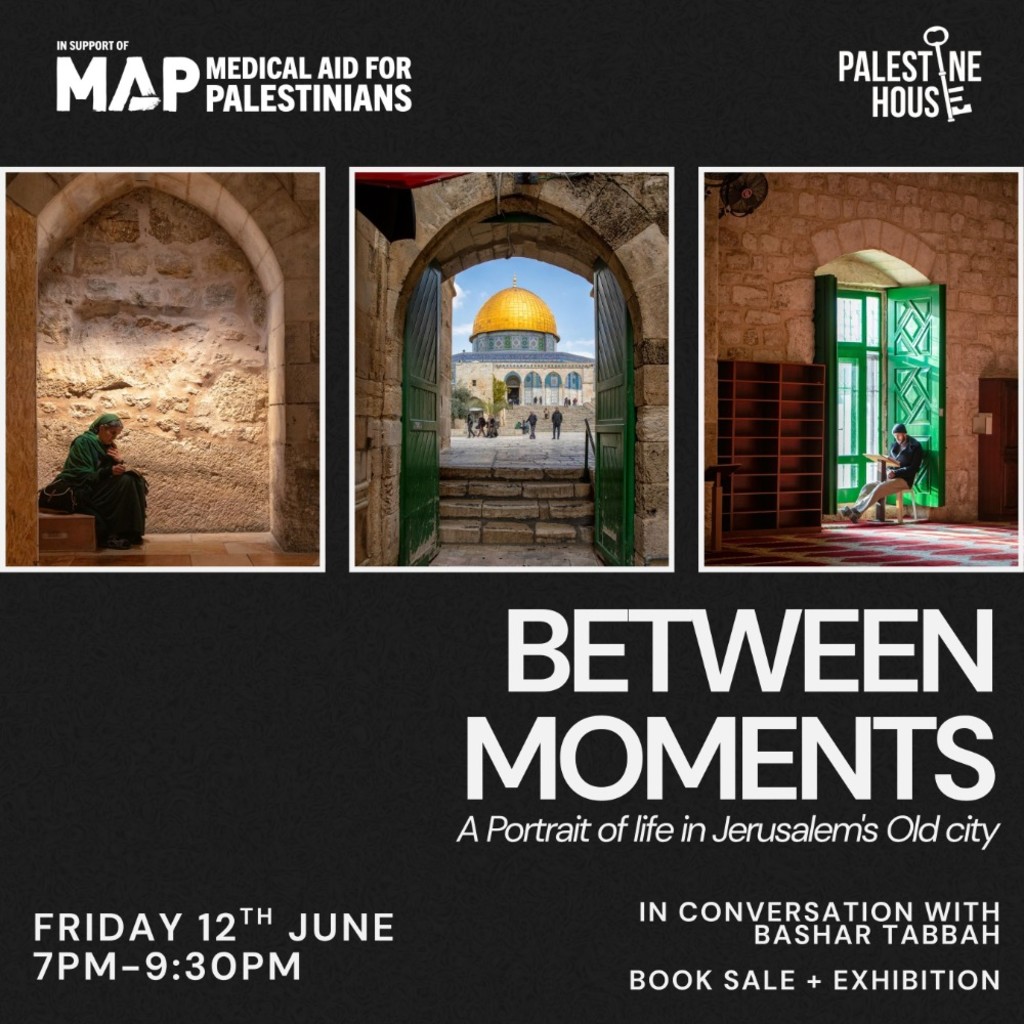
Join Palestine House for an evening talk and book signing with photographer Bashar Tabbah, as he shares his work documenting life in the Old City of Jerusalem and the journey behind his recent publication, Between Moments.
Through intimate photography and personal reflection, the book explores everyday life, memory, and resilience within the historic streets of Jerusalem.
All proceeds from Between Moments are dedicated to fundraising for Medical Aid for Palestinians, supporting vital medical and humanitarian aid for Palestinians.
Find out more and get your tickets here.
Become a Paying Subscriber Today
We hope you’re enjoying the free Weekly Dispatch and our new bi-monthly publication, The Key, a new online magazine dedicated to covering Palestine as the core issue at the heart of the modern world.
We are committed to making as much of our work free on publication as possible, and to do that we need to build up a community of paying subscribers, starting at $2 per month.
Since launching this subscription drive in March we have 830 paying supporters already - thank you so much to everyone who has come on board already: it’s been a brilliant start.
For $2 a month, subscribers get new articles on The Key direct in their inbox as well as full access to its growing archive.
At $10 a month we’ve organised for 10% discounts at bookshops and publishers around the world, as well as in our own shop - and a tote bag or supporter pin in the mail.
For $15 you’ll get a PalFest Bookshelf subscription - that’s all of the above plus a carefully curated book in the mail every two months, along with a unique artwork postcard.
There are even more options at $25 and above - check out our Subscriber tiers and see what might work for you.
Across all our publications and live events we are building platforms for work committed to the liberation of Palestine and resistance to colonialism. Your support will directly result in the production and publication of new work.
New York: Homosexual Intifada Book Launch, 16 June

Celebrate the launch of a groundbreaking new collection amplifying the voices of LGBTQ+ Palestinians across the diaspora and homeland.
Join co-editors George Abraham and Hannah Moushabeck, alongside contributor and journalist Afeef Nessouli, for an evening of readings, conversation, and community as they explore themes of identity, resistance, and love.
This special event offers a rare opportunity to hear directly from the queer Palestinian writers and artists that challenge dominant narratives, confront erasure, and affirm the richness and resilience of queer Palestinian life. A book signing will follow the discussion. Publisher proceeds of this book will be donated to Palestinian LGBTQ+ human rights groups.
Media Roundup
As Long as There Is Football – Writing on the eve of the World Cup, Mohammed Mhawish considers the social history and cultural significance of football in Palestine.
A Place They’ve Never Seen: Imagining Palestine from Lebanon’s Camps – Sarah Al Shaladeh speaks to Palestinians in refugee camps in Lebanon to plumb their geographies of family history and imaginations of return.
Al-Aqsa: The Moment of Peril Is Here. Will the Muslim World Act? – Ismail Patel argues that a newly-revealed US/Israeli plan to strip Jordan of custodianship of Al-Aqsa Mosque and to turn the mosque into a “multi-faith centre” constitutes a “final act of colonisation” by Israel.
The Geography of Complicity: Supply Chains and Global Resistance – Following revelations that Italy has played a crucial role in the supply chain for Israel’s military, Alessandra Pellegrini maps a network of complicit ports, calling for acts of portworker solidarity and refusal like those during the struggle against apartheid in South Africa.
As Israel Encroaches Upon Gaza, the UN Should Be Reckoning With Its Colonial Complicity – Ramona Wadi describes the fecklessness of the United Nations in Gaza, particularly as Israel continues to advance its so-called yellow line to 70 percent of the territory with the full support of the so-called Board of Peace.
Gaza Is Being Offered Coercion, Not Reconstruction – Said Arikat shows that the Board of Peace’s plan for the future of Gaza “does not aim to rebuild Gaza. It aims to coerce it. Reconstruction has been transformed from a humanitarian obligation into a political weapon.”
“You Either Leave Right Now or You Die”—Israel’s Ethnic Cleansing of a Village in Lebanon – Reporting from southern Lebanon Lylla Younes writes about the forced expulsion of residents in Ain Arab, where Israeli soldiers went door to door and threatened residents at gunpoint.
Israel Tortured These Activists. Now They're Speaking Out. – Saliha Bayrak reports on widespread experiences of violence, sexual abuse, and torture among participants in the latest freedom flotilla that aimed to break the Israeli siege on Gaza.
How the IHRA Definition of Antisemitism Is Being Used to Criminalize Palestine Solidarity Across Latin America –Blanca Missé examines how the criminalization of Palestine solidarity as antisemitic also targets the backbone of Latin America’s social movements.
If We Can Intifada the Poems… – Two new poems by George Abraham, from their forthcoming collection When the Arab Apocalypse Comes to America: “If we can believe in water, then we can believe in the un-countrying / of water, the un-surfacing of corpses, the lunar un-ease, for now. / If we can un-green the music, un-yellow the eyelids, un-red the impossible / wounds — if we can intifada the poems, they will only be elegies for now.”
One way everyone can support this free newsletter, every week, is with a quick click on the link below from Proton Mail. You don’t need to do anything else - just click.
ADVERTISEMENT:
Take control of your chaotic inbox

Stop drowning in spam. Proton Mail keeps your inbox clean, private, and focused—without ads or filters.
ADVERTISEMENT OVER.
This Month on the PalFest Bookshelf

Subscribers to the PalFest Bookshelf will this month be receiving Your Presence is a Danger to Your Life, just published by Fitzcarraldo Editions.
We wanted to share a little bit more about this crucial book with you.
In Your Presence is a Danger to Your Life the Syrian writer Samar Yazbek brings together the first-person testimonies of survivors of the genocide in Palestine that she spent three months with after their evacuation from Gaza between March and June, 2024. In this act of gathering together the particularities of each person’s narrative, a collective history is built, one that tells of agonizing individual losses as well as revealing the patterned, structured brutality of the Israeli genocide in Gaza. The methods and technology of that genocide are usually talked about in factual, distant language. Yazbek brings us the consciously recounted experiences of human beings who have witnessed and survived mass killing by artificial intelligence, forcing that consciousness back into a method of war which, Yazbek writes, turns life "into mere code...death into a human state digitally translated."
There is pain in this book, as well as a clinging to life. It is tempting to think of it as a book for future generations who will try to understand what happened in this dark time of over-exposed crimes against humanity. We think of it as a book for now, a book that works against the crude reduction of the suffering of the genocide, its normalization into the category of unavoidable, unstoppable atrocity, the pretense that we can understand anything at all about it, or about what it means for our shared futures, without sitting with the experiences of those who have been through hell, are still there, and still speak.
To receive the book please click through to the PalFest Bookshelf or subscribe through the Key.
That’s it for this week. We’ll be back on Monday morning with next week’s dispatch. Until then, if you’re still reading, then you must be glad to receive it - and you can support it with a final click from the sponsored ad from Protonmail below.
Free email without sacrificing your privacy

Gmail tracks you. Proton doesn’t. Get private email that puts your data — and your privacy — first.
