Hello and welcome to our weekly dispatch.
With Lebanon under continuing Israeli bombardment, it feels fitting to begin this week’s dispatch with an excerpt from Mahmoud Darwish’s book Memory for Forgetfulness, translated by Ibrahim Muhawi, where he narrates his solitary exile in Beirut during the Israeli invasion of Lebanon in 1982. He writes:
The occupied sky, sea, and pine mountains keep on shelling original fears and the saga of Adam's exit from Paradise, repeated in endless sagas of exodus. I no longer have a country: I no longer have a body. The shelling continues to shatter the songs of praise and the dialogue of death, stirring in the blood like a light consuming inane questions.
What am I searching for? A fullness of gunpowder and an indigestion of the soul's anger. The rockets penetrate my pores and come out safe. How powerful they are! As long as I'm breathing hell and sweating out an inferno, I no longer feel the Gehenna meted out by the air. Yet I want to break into song. Yes, I want to sing to this burning day. I do want to sing. I want to find a language that transforms language itself into steel for the spirit-a language to use against these sparkling silver insects, these jets. I want to sing. I want a language that I can lean on and that can lean on me, that asks me to bear witness and that I can ask to bear witness, to what power there is in us to overcome this cosmic isolation.
Then, as now, the people of Lebanon have proven steadfast against Israel’s annihilatory project.
This week in the newsletter we have:
Book events in New York & London for Molly Crabapple and Sondos al-Saqqa
A benefit screening of Gaza Surf Club
The US debut of Randa Jarrar’s critically-acclaimed performance The Last Palestinian
The Book of the Week by Sara Abou Rashed
Your weekly Media Roundup
Upcoming Events
New York: Molly Crabapple in conversation with Ibtisam Azem, 13 April (tonight!)
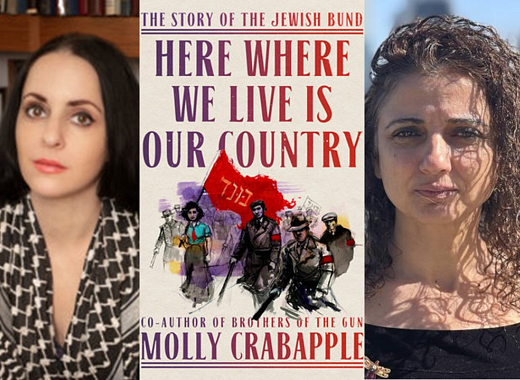
BPL Presents welcomes back Molly Crabapple, who discusses Here Where We Live Is Our Country, the dramatic story of the Jewish Bund—a revolutionary movement from a vanished world—and its radical vision of solidarity in an age of division. Molly will be in conversation with author Ibtisam Azem. This conversation is co-presented with Lux Magazine.
In the aftermath of the Holocaust, Sam Rothbort created “memory paintings” with the hope of resurrecting the vanished world of his shtetl childhood. Decades later, his great-granddaughter, the award-winning artist Molly Crabapple, discovered these paintings and one stood out: a girl, her dress the color of sky, hurling a rock through a cottage window. Itka the Bundist, Breaking Windows.
Itka is how Crabapple met the Jewish Labor Bund. Once the most influential Jewish political force in eastern Europe, the Bund was secular, socialist, and uncompromisingly anti-Zionist. The Bundists fought for dignity and equality, not in an imagined homeland in Palestine but “here where we live.”
In the first popular history of the Bund, Crabapple re-creates their extraordinary world through dramatic portraits of insurgent poets and antireligious rebels, clandestine revolutionaries and lovers on the barricades. The Bundists live deeply within this violent, volatile, and somehow hopeful period, as their stories interweave with the Russian Revolution and the Holocaust. The Bund’s rise and fall raises the vital question: What can we learn from a movement that, for all its toughness, imagination, and moral clarity, was largely destroyed?
Here Where We Live Is Our Country reanimates a band of idealists who broadened our global political imagination. As we once again contend with nationalism, repression, and the struggle for belonging, the Bund’s remarkable story and message—that liberation, dignity, and solidarity must begin where we stand—reaches across time as a guide to our own urgent moment.
New York: Water as Freedom - A Palestinian Cinema Night, 22 April
Join Cobble Hill Cinemas for a night of Palestinian short films and a documentary about surfers from Gaza, to raise funds for families in Gaza whose homes and livelihoods come from the sea. This event is organized by Friendly Strangers Studios and Reem Jubran, and co-sponsored by Banat El Waves (بنات الويڤز) and PaliSurferChicks.
Gaza Surf Club is a 2016 documentary film directed by Philip Gnadt and Mickey Yamine which follows several surfers from Gaza and documents their efforts to surf and survive.
The program will also feature two short films: The Sea is Ours by Banna Bazzarie, and Don’t Be Long, Little Bird by Reem Jubran.
Tickets are available on a sliding scale with all proceeds going to support families in Gaza.
Become a subscriber to PalFest & The Key
By now you’ve heard about The Key, our brand-new online magazine which is dedicated to covering Palestine as the core issue at the heart of the modern world.
We are committed to making as much of our work free on publication as possible, so have launched our new subscription drive.
Across all our publications and live events and we are building platforms for writers and thinkers whose work is committed to the liberation of Palestine and resistance to colonialism.
We hope you would consider supporting our work by becoming a paid subscriber.
For $2 a month, you’ll get new articles on The Key, as well as full access to its growing archive and the PalFest Podcast - and you’ll be the first to know about our upcoming events in your city.
At $10 a month we’ve organised for 10% discounts at bookshops and publishers around the world, as well as in our own shop.
For $15 you’ll get a PalFest Bookshelf book selection in the mail every two months, along with unique extras.
There are even more options at $25 and above - check out our Subscriber tiers and see what might work for you.
Thanks for supporting our work.

London: Dear Sondos Book Launch, 22 April
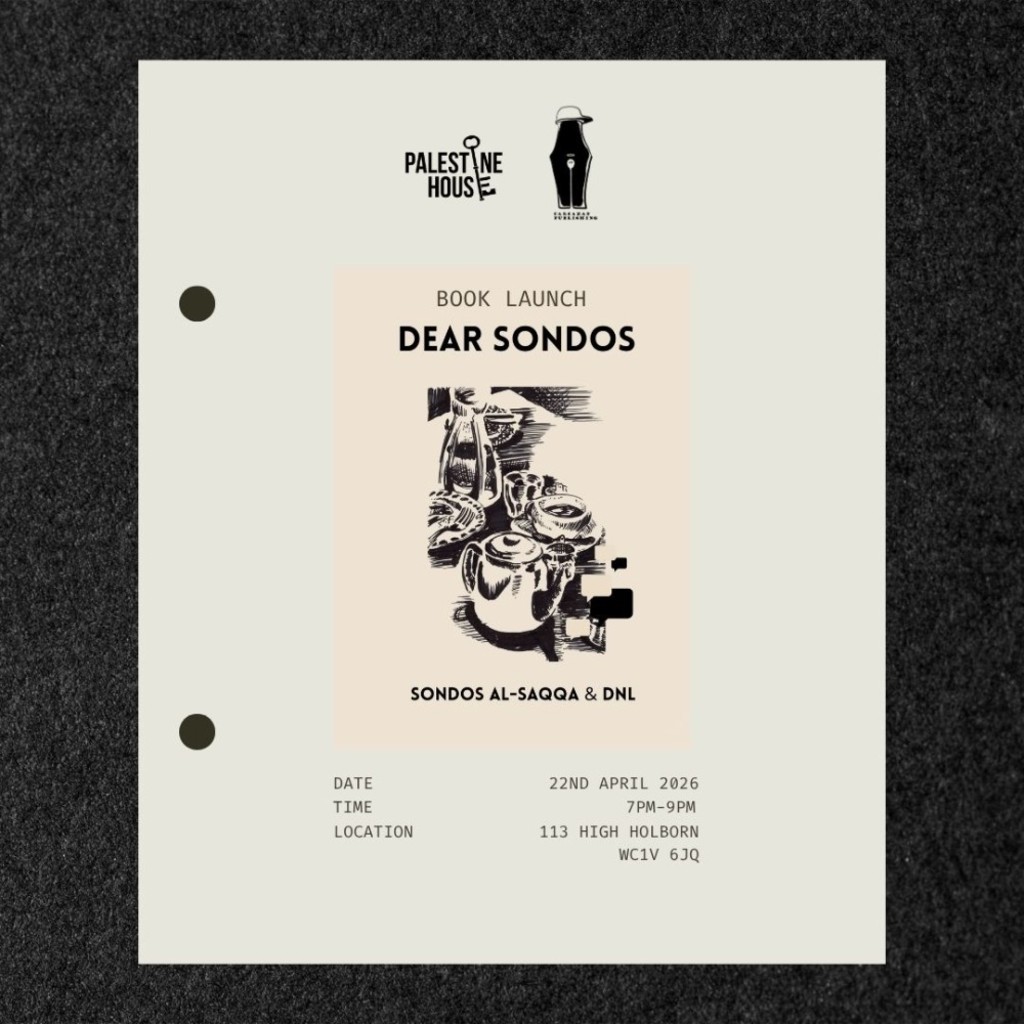
Join Palestine House on 22 April for the launch of Dear Sondos, a deeply moving and unexpected story of friendship that transcends borders, identities, and lived realities.
Born out of a simple act of support and a shared love of writing, Dear Sondos traces the real-life correspondence between Davie, a Jewish writer from New York, and Sondos, a Palestinian poet in Gaza. What begins as an exchange of messages soon unfolds into an intimate dialogue—one that bridges distance, dismantles assumptions, and reveals the quiet, powerful threads of humanity that connect us all.
Through their words, we are invited into two parallel worlds shaped by conflict, displacement, and resilience. Yet within these realities, something tender emerges: empathy, curiosity, humour, and even a shared love of donuts. As Davie and Sondos come to know one another, so too do we—witnessing a relationship that challenges dominant narratives and insists on connection in the face of separation.
This special evening will celebrate not only the release of this remarkable debut, but also the voices behind it. With readings, reflections, and conversation, we will explore the story behind the book, the process of collaboration across borders, and the enduring power of storytelling as a form of resistance, healing, and hope.
San Francisco: Randa Jarrar’s The Last Palestinian, 26 April
The Last Palestinian is a solo show which charts humanity’s spectacular downfall. This dark dramedy, written and performed by Randa Jarrar and directed by D’Lo, “channels rage with absurdist humor and outlandish hypotheticals [to] reimagine justice.”
Wrapped in a shroud, Asheerah wakes up in 2055 and comes to realize that she is the last person on Earth. She finds a friend, a hologram that carries the consciousness of Italian legal scholar and expert on human rights, Francesca Albanese. Asheerah learns, through Francesca’s history channels, how the world ended, and how those who resisted carried out justice before their demise.
The show debuted at Edinburgh Fringe last year and is now embarking on its first US tour. This performance will mark its US debut, and is not to be missed.
Book of the Week

Theories of Return is an urgent and unflinching poetry collection that resists both literal and literary erasure, asserting the right to exist. In these pages, Sara Abou Rashed’s voice does not ask permission but commands attention, bearing witness to exile while refusing silence. As much as the book honors her family’s displacement from Palestine to Syrian refugee camps and later to the U.S., it is ultimately collective rather than confessional, pressing outward to ask universal questions about the ethics of war, ownership, language, motherhood, and intimacy. Each poem operates as its own theory and attempt at return, binding abstraction to lived experience, and inherited history to the brutal clarity of the present moment. Formally daring and emotionally exacting, Theories of Return offers readers poetry that is intellectually rigorous, deeply human, and unafraid to speak.
Theories of Return is a searing and intimate poetry collection that reckons with exile, inheritance, and the impossible mathematics of going back. Moving between Gaza, Syria, Palestine, and the diasporic present, Sara Abou Rashed braids lyric intensity with political clarity, refusing abstraction in favor of lived consequence, bodies, borders, language, and grief that multiplies across generations. These poems examine what return means when home is inaccessible and memory is fragmented. Identity is forged under occupation and displacement, yet also insists on tenderness, dark humor, and fierce intelligence as modes of survival. At once formally inventive and emotionally direct, Theories of Return speaks to readers drawn to poetry that confronts history without sacrificing intimacy and that understands language itself as a site of resistance, mourning, and fragile hope.
Theories of Return is out now from Diode Editions.
And now a Word from a Sponsor
As we try to build a self-sustaining media platform that keeps Palestine at its heart, we are experimenting with certain adverts that will pay us $1+ for one click from you. So if you’d like support this newsletter, give the below advert a quick click . . .
Tired of news that feels like noise?
Every day, 4.5 million readers turn to 1440 for their factual news fix. We sift through 100+ sources to bring you a complete summary of politics, global events, business, and culture — all in a brief 5-minute email. No spin. No slant. Just clarity.
Media Roundup
The Hungering Years: Summer Farah on Holding a Magnifying Glass to Everything – Laura Villareal interviews Summer Farah about her recent debut collection of poetry The Hungering Years: “I am constantly reminded of the success of normalization—through food, through television, and so on. It is a very lonely, alienating reminder. As I became conscious of this presence—which, in tandem, functions as the erasure of Palestine—I wanted to find the cracks, where Palestine pushed through.”
Palestine Solidarity Will Not be Cowed – Feyzi Ismail writes about the conviction of two leading Palestine solidarity organizers in the UK as part of the ongoing attempt to criminalize opposition to Israel.
“Together and United” – A Letter from George Habash to Sayyed Hassan Nasrallah following the July War in 2006, translated into English by Louis Allday. “This battle has exposed the falsehood of the deceptive peace rhetoric and has once again demonstrated with clarity the imperialist and Zionist ambitions to erase the alphabet of resistance from the Arab region’s lexicon.”
The Jewish Labor Organizers Who Challenged Zionism From the Start – Chenjerai Kumanyika speaks to Molly Crabapple about her new book, Here Where We Live Is Our Country, about how the Jewish Bund in Eastern Europe resisted Zionism and what their resistance can teach us about combatting Zionism today.
The Maroons – A sound composition by Firas Shehadeh thinking notions of fugitivity and refusal across Palestine, Lebanon, and Haiti.
‘What you, my good Israelis, said’: Sabri Jiyris's The Foundations of Zionism – Sasha Frere-Jones reviews Sabri Jiryis’ newly-translated history of Zionism, interviewing Jiryis for his thoughts on the book’s pertinence today.
On the US-Israeli Coalition’s Continued Acts of Scholasticide in the Middle East – Steven Thrasher describes how the systematic targeting and destruction of schools and universities in the multi-front US-Israel war on Palestine, Lebanon, Iran, and elsewhere puts scholars and students in danger everywhere else.
Education Crisis Deepens in the West Bank Amid Economic Collapse and Funding Cuts – Maleeha Haq examines how Israel’s withholding of Palestinian tax revenues has plunged an already-incapacitated education system into a worse crisis.
A Hundred Airstrikes in Ten Minutes – Loubna El Amine describes the logics of impunity that enable Israel’s ongoing bombardment of Lebanon, which are an extension of its exterminationist war on Palestine.
When Jewishness Means Genocide – Arielle Angel and Daniel May interview the philosopher Elad Lapidot about how Israeli impunity and Zionist power have altered what antisemitism is and how it operates in the world today.
How the War on Iran Revived the Axis of Resistance – Mohammad Ataie argues that the US-Israeli attempts to dismantle Iran’s regional power have done just the opposite, as evidenced by the coordinated response from insurgent groups in Lebanon, Iraq, and Yemen to the war.
Israeli Missile Interceptors Have Dwindled to “Double Digits”: Trump Administration Official – Ryan Grim and Murtaza Hussain report on how Israel is increasingly dependent on the US Navy’s defense capabilities due to the fact that it is running out of missile interceptors.
“Energy is at the heart of it” w/ Laleh Khalili – Laleh Khalili speaks to the Makdisi brothers about the geopolitical and geoeconomic contexts of the US-Israeli war of aggression on Iran, including the role of Iran and the Gulf in global energy and trade markets and circuits, as well as shifts in international trade and finance away from circuits controlled by the US and its coercive mechanisms of financial and trade sanctions.
Back From the Brink in Iran? Not While Palestine and Lebanon Burn – The editorial board of The New Arab argue that “there can be no lasting peace in the Gulf and the Middle East without ending the Greater Israel project and its threat to the entire region.”
Refer Friends for Free Books
If you’ve started reading The Key you can refer your friends with your unique reference code below. If five friends sign up we’ll send you a free .epub of Saleem Haddad’s brilliant new novel, Floodlines. Get twenty people signed up and we’ll mail you a copy of the Selected Plays of Ismail Khalidi!
OK, that’s it for this week’s newsletter. More next week.
