
Hello and welcome to our weekly dispatch.
This past weekend marked thirty years since the passing of Emile Habiby, Palestinian intellectual and author of the highly-acclaimed black comedy The Secret Life of Saeed the Pessoptimist. The book is considered to be one of the best novels in the Arabic language, using irony and absurdism to thematize the plight of the Palestinians at the hands of Israel. Habiby had firsthand experience of the ins and outs of the state, having served as an MP from the Israeli Communist Party sporadically from 1952 until his resignation in 1972. Habiby died in Nazareth on May 2, 1966. He was buried in Haifa, his birthplace, as he requested in his will. On his tombstone, it reads, “I remain in Haifa.”

This week in the newsletter we have:
An upcoming PalFest event in London between Molly Crabapple and Hazem Jamjoum to launch her new book Here Where We Live Is Our Country
A new episode of the PalFest Podcast featuring Lena Khalaf Tuffaha in conversation with So Mayer
A webinar with Abdeljawad Omar
A poetry event in London featuring Khalid Abdalla, Zena Agha, and many others
Adam Johnson’s How To Sell A Genocide as the Book of the Week
Your weekly Media Roundup
Upcoming Events
London: Here Where We Live Is Our Country Book Launch, 27 May

In 2015, we were honored to welcome Molly Crabapple to the Palestine Festival of Literature. She toured the West Bank and ‘48 with the festival and wrote a deeply affecting dispatch for Vice News from Gaza. When she returned home, she began excavating her family’s history and her great-grandfather’s involvement with the Jewish Bund — a revolutionary movement that was secular, socialist, and uncompromisingly anti-Zionist that reached its zenith in interwar Europe.
Now, 11 years later, she is about to publish Here Where We Live Is Our Country, an epic history of the Jewish movement that refused Zionism’s pressure to colonize and subjugate another people. It’s been largely erased from history, Molly argues, because of its opposition to Zionism — and her new book is an attempt to ensure it’s not forgotten.
Join us for the London launch at the Southbank Centre of Here Where We Live is Our Country.
Crabapple joins cultural historian, archivist, translator and educator Hazem Jamjoum in conversation. He is the lead editor at Safarjal Press and recently translated Ghassan Kanafani’s The Revolution of 1936–1939 in Palestine and Maya Abu Al-Hayyat’s No One Knows Their Blood Type.
New on the PalFest Podcast: Lena Khalaf Tuffaha speaks to So Mayer

On this episode of the PalFest podcast, we mark the launch of the UK edition of Lena Khalaf Tuffaha’s Something About Living, published by the 87 Press, at the London Review Bookshop.
Lena Khalaf Tuffaha is one of the most influential Palestinian poets working in English today. Her collections have won multiple prizes and her poems have been published across the spectrum of poetry magazines.
So Mayer is a writer, editor, bookseller, organiser and film curator. Their most recent book is Bad Language, published by Peninsula Press in 2025, a memoir and manifesto on language and power.
Thanks to the LRB Bookshop for the event and the recording.
This episode was recorded in London on March 16th, 2026.

Become a subscriber to PalFest & The Key
By now you’ve probably read something over at The Key, our brand-new online magazine which is dedicated to covering Palestine as the core issue at the heart of the modern world.
We are committed to making as much of our work free on publication as possible, so have launched our new subscription drive.
Across all our publications and live events, we are building platforms for writers and thinkers whose work is committed to the liberation of Palestine and resistance to colonialism.
We hope you would consider supporting our work by becoming a paid subscriber.
For $2 a month, you’ll get new articles on The Key, as well as full access to its growing archive and the PalFest Podcast - and you’ll be the first to know about our upcoming events in your city.
At $10 a month we’ve organised for 10% discounts at bookshops and publishers around the world, as well as in our own shop.
For $15 you’ll get a PalFest Bookshelf book selection in the mail every two months, along with unique extras.
There are even more options at $25 and above - check out our Subscriber tiers and see what might work for you.
Thanks for supporting our work.

Virtual: The Ongoing Nakba with Abdeljawad Omar, 14 May
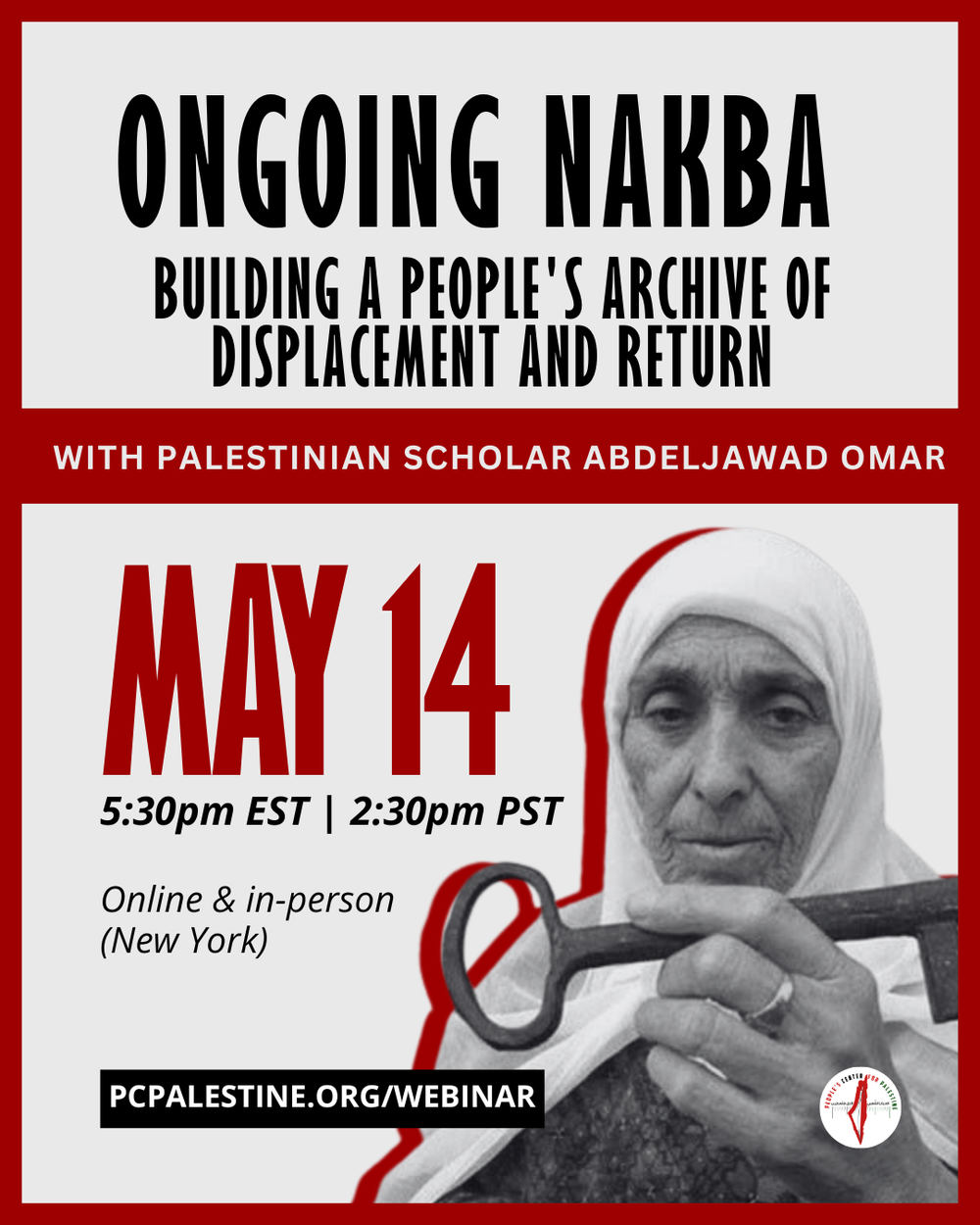
Join the People’s Center for Palestine for a hybrid webinar with Palestinian writer, political analyst, and academic Abdeljawad Omar of Birzeit University. This event will reflect on the scale of loss in 1948 and explore what it means to speak of an “ongoing Nakba, ongoing return” across generations—from the homeland to the diaspora. After 78 years, more than four million Palestinian refugees continue to live the reality of the Nakba. How do we carry and defend this collective narrative in the face of the ongoing genocide in Gaza?
This webinar also invites participants to contribute to a people’s archive of testimonies of the ongoing Nakba, as part of an effort to collect stories of displacement and its ongoing impact.
London: Voices from the Nakba, 12 May
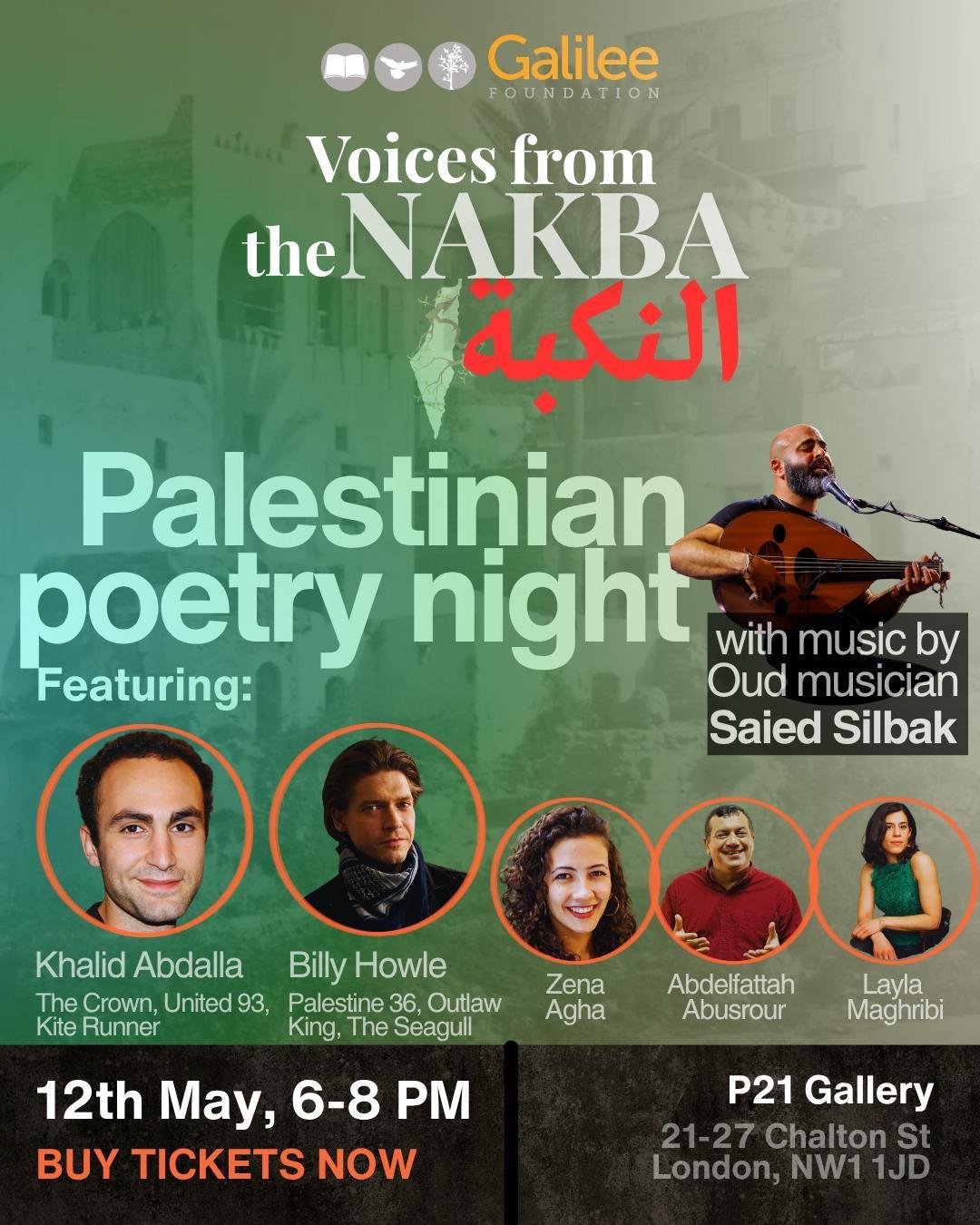
Join P21 Gallery for an evening of poetry and music featuring readings by actors Khalid Abdalla and Billy Howle, Palestinian poets Abdelfattah Abusrour, Zena Agha, and Layla Maghribi, and music by Saied Silbak.
Ticket proceeds go towards much-needed projects supporting the education and future of young Palestinians.
Book of the Week

As bombs rained down on Gaza in October 2023, images of mass death and destruction gripped the world, and openly genocidal statements from Israeli leaders foretold the magnitude of horrors to come. But the US media was quick to downplay, obscure, and repackage an emerging campaign of extermination into a slick “war on terror” framework.
How to Sell a Genocide is a thorough indictment of US corporate media’s role in enabling—and, at times, directly inciting—one of the most devastating campaigns of mass killing in modern memory. Johnson unpacks how major news outlets like The New York Times, CNN, and MSNBC systematically sanitized Israel’s war crimes, hid the US’s central role, and dehumanized the Palestinian people.
Drawing from deep, original data-driven analysis, Johnson dissects the mechanics of propaganda, from the selective empathy, strategic omissions, overt racism and repetition of state-sanctioned falsehoods, to the demonization of humanitarian workers and dishonest coverage of campus protests. With clarity and moral force, Johnson argues that the genocide could not have been sustained without the active, sustained complicity of the US media.
How to Sell a Genocide is out now from Pluto Press. All royalties from the book will be donated to the Middle East Children’s Alliance.
Support The PalFest Weekly Dispatch
We are experimenting with certain adverts that will pay us for one click from you. Help us keep publishing this free newsletter and click on the advert from email server Beehiiv, below, and they will pay us a quite incredible $3 for every single click.
It’s a very easy way to help us keep this operation going!
The New Trick to Reducing Stress Without Losing Focus

Trapped in the cycle of workplace burnout making it hard to focus, leading to more stress? You need CBDistillery’s new Daytime Calm gummies. With 50mg of CBG, shown to increase focus and reduce stress, each gummy is formulated for daytime focus and stress support – and code COOL saves you 25%.
Media Roundup
Why I’m Running for Office from Prison – Amu Gib, one of five pro-Palestine activists imprisoned for allegedly breaking into a British military airbase last year, explains why they’re running for council in north London from behind bars.
“Paradise”—A Short Story – In this short story by Aisha Abdel Gawad, a young man in Gaza moves between rubble, work, and the sea, holding onto fleeting moments of dignity and fragile illusions of normal life.
May Goes On: (Re)-Introducing May Ziadeh – Ibtihal Rida Mahmood offers a biography of the Palestinian writer May Ziadeh, born in 1886 in Nazareth and the object of renewed attention by a collective of women translators and editors who are working on a new translation of her genre-defying work Sawanih Fatat.
How a Palestinian Prisoner Won the Booker Prize – In this Arabic-language episode of the Tarwida podcast, Tala Elissa speaks to Bassem Khandaqji about writing secretly at 4am in Israeli prison, smuggling manuscripts out of detention, and how imagination helped him survive and resist.
After the Encampments—A Roundtable with Student Organizers on Palestine, the University and What Comes Next – In this roundtable moderated by Maya Wind, student orgqanizers from Italy, France, the UK, the US, and Germany reflect on how campus organizing has changed since the spring 2024 encampments at universities around the world.
How Israel Is Weaponizing Infectious Diseases in Gaza – Dr. Salman Khan, an infectious disease specialist who traveled to Gaza on a three-week medical mission in February 2026, found that Israel’s siege and genocide was a direct cause for the proliferation of infectious diseases in Gaza.
The War on Gaza Has Not Ended – Writing from Gaza, Asem Alnabih describes how the conditions of siege, starvation, and displacement, combined with new forms of control and surveillance, have only deepened the effects of Israel’s genocidal war on Gaza.
Why Did the British Museum Remove References to Palestine? – Lydia Wilson reports on the ongoing controversy concerning the British Museum’s decisions to remove the word “Palestine” from a significant number of its exhibitions.
Gaza’s Medical Evacuation Crisis Is Leaving Thousands Without Care – Anna-Christina Schmidl reports on how Israel is imposing political constraints and logistical barriers to keep critically ill patients in Gaza from receiving treatment in the West Bank, Egypt, or elsewhere.
Illegal Siege, Brutal Abuse: Our Detention and Assault at the Hands of Israeli Prison Guards – Writing in the wake of Israel’s seizure of 22 ships and detention of more than 170 people in the most recent Global Sumud Flotilla, Noa Avishag Schnall and Anna Liedtke, describe their abduction and abuse by Israel last fall.
Hiding Behind Procedure: How the EU Attempts to Sidestep Obligations on Israel – and Why They Fail – Andrea Teti describes how the European Union breaks its own rules and international law to avoid sanctioning Israel on its crimes in Palestine and elsewhere, consigning itself to irrelevance in the process.
Limbo in the South: Despite Ceasefire, Lebanon’s Displaced Still Await Political Pathway – Lana Harb and Ehsan Salah report from the south of Lebanon on how the embattled role of Hezbollah in the ostensible ceasefire has left millions of people displaced by Israel’s unlawful war and occupation in a state of limbo.
nothing is ever lost – In this explosive poem sequence, an anonymous writer searches the capital-ravaged landscape and discovers a life-affirming struggle: “remember / this glimpse beyond the world’s end & return / with its nurtured depths to the tunnels to the caves to the camps / to plead with the dead to spare the living to share the secret of resistance / for one day each would have to renew earth’s beauty for the others.”
Refer Friends for Free Books
If you’ve started reading The Key you can refer your friends with your unique reference code below. If five friends sign up we’ll send you a free .epub of Saleem Haddad’s brilliant new novel, Floodlines. Get twenty people signed up and we’ll mail you a copy of the Selected Plays of Ismail Khalidi!
‘Til next week.
