
Hello, and welcome to this week’s dispatch.
Scroll down for:
An exclusive reflection on the current PalFest Bookshelf selection by the acclaimed poet Zena Agha;
An event in London on Gaza’s 7000-year history;
A documentary screening and fundraiser in Los Angeles;
A book talk in New York in support of the Holy Land Foundation 5;
Hajer Mirwali’s Revolutions as your Book of the Week; and
Your weekly Media Roundup.

From the PalFest Bookshelf: Zena Agha on Samar Yazbek’s Your Presence Is a Danger to Your Life

The June/July pick for the PalFest Bookshelf is Your Presence is a Danger to Your Life by Samar Yazbek, translated by Leri Price. We asked the poet Zena Agha for her impressions of the book:
The title Your Presence Is a Danger to Your Life could be mistaken for irony were it not for the morbid reality that these words were printed on leaflets dropped from the skies above Gaza before deadly aerial bombardments. This was during the 2008–09 assault on the besieged Strip. Edited by Syrian writer Samar Yazbak, the book comprises 26 testimonies from survivors aged 13 to 65, collected during the first year of the genocide (2023–present).
I confess I did not read the book conventionally. The weight of it - the horror, and the devastating candour with which that horror is expressed - at times proved too much to bear. The book sat on my shelf, drawing my eye whenever I passed it. In the end, I read it in fits and starts, one randomly selected account at a time over several weeks. The effect was to bring home just how widespread the practices of indiscriminate killing, torture, incarceration and displacement were and continue to be.
These reflections should not take away from the book's importance. On the contrary, after years of witnessing horrific images on our phones, there is profound power in reading the testimonies of survivors - not as voyeurs, nor as people fleetingly exposed to Palestinians' most private pain, but as interlocutors. By this I mean that the reader receives an account of genocide intentionally, shared by those who lived it. There is great power in this exchange. The book is not a monument to sit on a shelf, but an affirmation of the importance of witness and of the ongoing negotiation of narration. In this way, the book becomes a political statement we can return to again and again.

London: 7000 Years of History in Gaza, 10 July
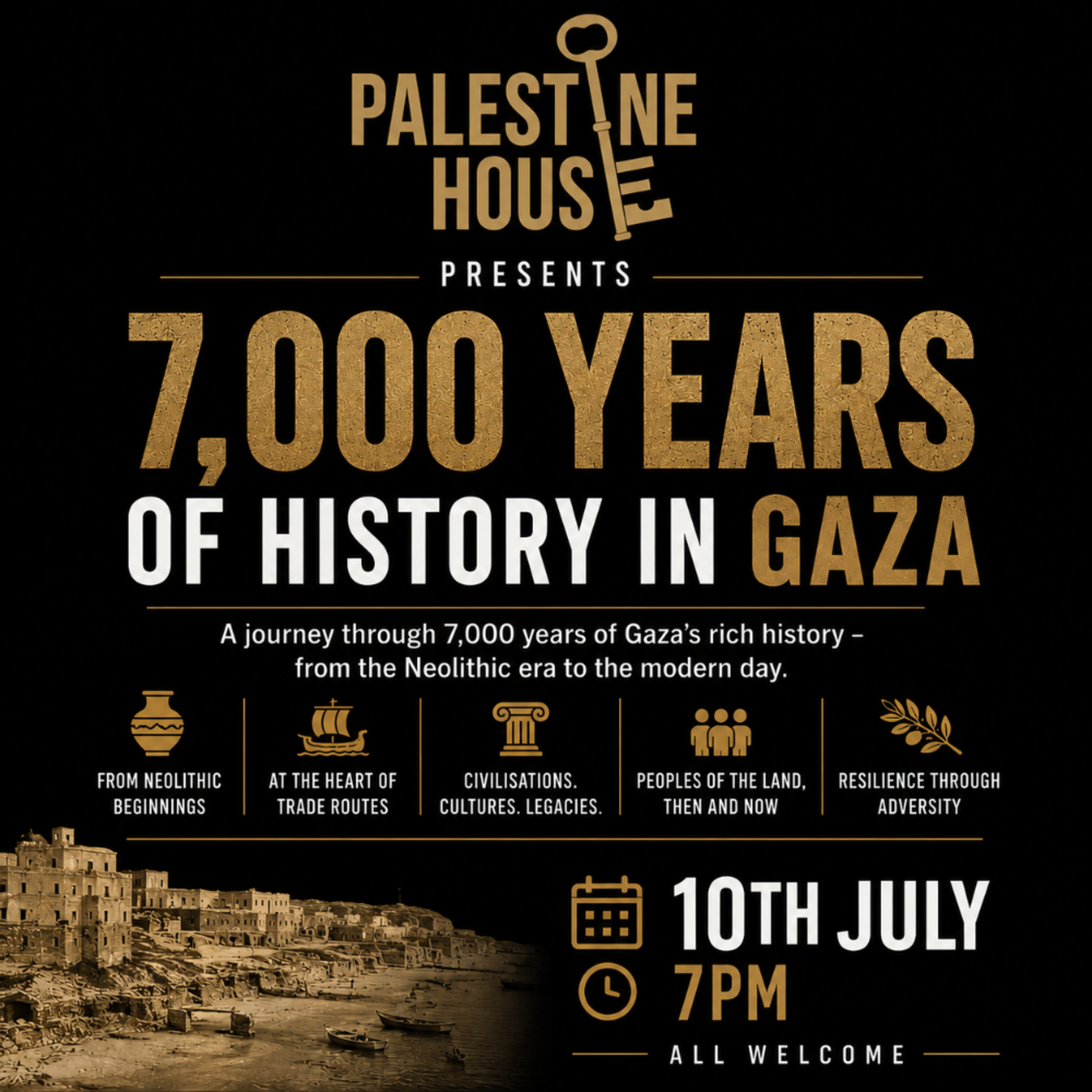
Join Palestine House for an engaging historical presentation exploring 7,000 years of Gaza's rich and enduring past, from the Neolithic era to the present day.
This lecture traces Gaza's development through successive historical periods, examining its strategic location at the crossroads of ancient trade routes and the many civilisations that have shaped its cultural, economic, and social landscape. Attendees will gain insight into the region's historical significance, the cultural contributions of the peoples who lived there, and the archaeological and historical evidence that documents Gaza's long record of human settlement.
The presentation will also explore the continuity of the communities that have inhabited the land throughout recorded history and reflect on the resilience and perseverance of the people of Gaza in the face of centuries of political change, conquest, and conflict.
Los Angeles: Seeds for Liberation Screening and Fundraiser, 18 July

Communal Press & Midnight Books host Seeds for Liberation, by Matthew Solomon & Donna Hadjikhani (Reimagining Safety) and Alana Hadid.
Seeds for Liberation is the new documentary from Director Matthew Solomon (Reimagining Safety) & Executive Producers Alana Hadid and Donna Hadjikhani (Reimagining Safety), that highlights the Free Palestine movement and its connections to Black, Chicano, and collective liberation.
Featuring some of the biggest names in the movement, from Palestine to Stop Cop City, Seeds for Liberation is both powerful and inspiring, spanning decades of solidarity and culminating in reflections on what liberation and a free Palestine truly mean.
Subscribe to The Key
We’ve just launched the tenth issue of The Key, our landmark online magazine that places Palestine at the center of the world. The new issue features an essay on Israeli imperialism in Nigeria, a stirring poem from Gaza, and more.
There are very few platforms publishing work like this. Indeed, across all our publications and live events, our goal is to expand platforms for writers and thinkers whose work is committed to the liberation of Palestine and resistance to colonialism.
While we are committed to keeping this work free upon publication, we depend on paid subscribers to ensure we can support the writers producing this work. So we hope you would consider supporting this work by becoming a paid subscriber.
For $2 a month, you’ll get new articles on The Key, as well as full access to its growing archive and the PalFest Podcast - and you’ll be the first to know about our upcoming events in your city.
At $10 a month we’ve organised for 10% discounts at bookshops and publishers around the world, as well as in our own shop.
For $15 you’ll get a PalFest Bookshelf book selection in the mail every two months, along with unique extras.
There are even more options at $25 and above - check out our Subscriber tiers and see what might work for you.
Thanks for supporting our work.

New York & Online: Light from Deep Under Book Talk, 18 July

Join Durub and Within Our Lifetime on Saturday, July 18th for “Light from Deep Under: Free the HLF5! Free Them All!” a hybrid book talk & community gathering from 6-8 pm in person at Another World and online on Zoom.
Nida Abu Baker, daughter of U.S. Palestinian political prisoner Shukri Abu Baker of the Holy Land Foundation 5, will be speaking virtually at the event. Nida will discuss the ongoing struggle to free her father and fellow HLF5 political prisoner Ghassan Elashi and read from Shukri’s book Light From Deep Under: Writing and Art from a Palestinian Prisoner, which was published in 2025. Books will be available for purchase at the event.
The event will also feature a letter writing portion, where attendees will be provided stamped envelopes and writing materials to write Shukri and Ghassan letters in solidarity.
Find out more here, and register here to attend virtually.
Book of the Week

Revolutions sifts through the grains of Muslim daughterhood to reveal two metaphorical circles inextricably overlapping: shame and pleasure.
In an extended conversation with Mona Hatoum’s artwork + and –, Revolutions asks how young Arab women – who live in homes and communities where actions are surveilled and categorized as 3aib or not 3aib, shameful or acceptable – make and unmake their identities.
Working between a Palestinian and Iraqi poetics drawing from artists like Mahmoud Darwish and Naseer Shamma and a feminist Canadian poetics inspired by Erín Moure, M. NourbeSe Philip, and Nicole Brossard, Revolutions spirals and collapses as we turn and re-turn around its circles.
Revolutions is out from Talon Books.
Media Roundup
What Do You Do When You See Your Country Disappearing? – An interview with Palestinian-French writer Karim Kattan about how the past several years have reshaped his relationship to literature, the politics of writing in French, and identity: “Faced with the current genocide in Gaza, institutional censorship, and the systematic attempt to silence and marginalize Palestinian voices in places like France, embracing this identity has become a political and moral obligation.”
‘I Would Never Release Him’: Marwan Barghouti and Palestine’s Future – Muhammad Shehada describes the stalemate of electoral politics in Palestine today, and draws on examples from South Africa to consider paths out of Israeli apartheid.
Are the "Birth Pangs" of a New Middle East Finally Here? – Amal Ghandour considers whether the war on Iran and its fallout in the region could prove to be the harbinger of a version of the Middle East unwanted by the United States and Israel.
Resisting Palestinian Erasure in an Age of Genocide – Adrianne Kalfopoulou reviews Tareq Baconi’s Fire in Every Direction: “There is ultimately no ‘return’ to any place of origin as those places have either been fundamentally changed or lost, but rather…there is ongoingness; private geographies intersect with physical geographies and existing realities embody belonging as an assemblage.”
The ICJ Opinions on Palestine: Possibilities and Limitations – Dana Farraj analyzes whether the ICJ’s decisions about Israeli war crimes and crimes against humanity can be leveraged to advance legal and diplomatic accountability at the international and domestic levels.
Do Pro-Palestinian Activists Have the Right to a Fair Trial Anymore in Europe? – Eliška Koldová, Michaela Švandová, and Maja Vusilović report on the case of Youssef Moursi, a Czech activist who has been held in pretrial detention for more than two months for alleged involvement in a fire at an arms factory, to consider how the law violates itself in order to repress the Palestine solidarity movement.
Israel’s Seizure of Palestinian Church Land Raises Renewed Fears of Efforts to Erase Christians From Jerusalem – Reporting from Silwan, Majd Jawad speaks to the Muslim caretaker of church land that Israel is seizing under the pretext of creating “green spaces.”
The Healthcare System Is Collapsing in the West Bank – Charlotte Ritz-Jack reports on the rising costs and dwindling resources of healthcare in the West Bank as a consequence of Israel’s systematic economic stranglehold over the Palestinian Authority and the deepening of the occupation.
Lebanon’s Surrender Agreement: Hezbollah Expert Amal Saad on Beirut’s “Framework” With Israel – Jeremy Scahill speaks to Amal Saad about the agreement between the Lebanese government and Israel on the disarmament of Hezbollah and the prospects of resurgent regional war.
Arming the State Against the Nation: The Illusion of a Military Solution in Lebanon – Jonathan Hassine examines the history of the Lebanese state’s failed attempts to quash the popular resistance, and the violence that such attempts bring about.
Gathering Our Remains: An Interview with Samer Abu Hawwash and Huda J. Fakhreddine on Palestinian Poetry at a Time of Genocide – Samer Abu Hawwash and Huda J. Fakhreddine speak to Alton Melvar M. Depanas “about the contours of Palestinian poetry at a time of genocide, and how there can remain ‘but the poem, the witness, the triumph against time, the signpost in the wasteland of history’”: “To translate Palestinian voices in this moment should be an act of resistance and reclamation: an effort to bend English, to create space within it for Palestine on its own terms, rather than an act of catering to the inadequacies or anxieties of the other.”
The Rhythm of Revolution – Zaina Alsous reviews the new edition of Enemy of the Sun: Poetry of Palestinian Resistance, as a testament to left internationalism and the anticolonial remaking of the world: “If poetry must hold the weight of catalyzing historic transformation, it is destined to come up short. Revolution, after all, has to do with who commands the guns, who owns the land, who holds the petroleum and the mines. But every break in the order of things might also return us to the long unbroken line of those who carried the flame when they too felt unsure of the path forward—a way to find and be found within an ever-emerging shared language.”
Thanks for reading. More next week.
