
Hello, and welcome to this week’s dispatch.
Scroll down for:
An archival workshop on Palestinian history with Dar Jacir in Bethlehem and online;
A discussion on “Literature as a Practice of Freedom” with Adania Shibli at the Khalil Sakakini Center in Ramallah and online;
A film screening with Palestine Youth Movement in New York;
A film screening with Palestine House in London;
leena aboutaleb’s collection THALASSA as your book of the week; and
Your weekly media roundup.

Bethlehem & Virtual: Time Before the Disaster, 14, 16, 18 July

Dar Jacir, working with researcher Chris Harding, is hosting Time Before the Disaster: Reading the Dar Jacir Archives on the Eve of al-Nakba.
This workshop will discussing newspapers and magazines from the late 1930s and 1940s, from Dar Jacir’s collection. Examining selected extracts from periodicals such as al-Ghadd, Huna al-Quds, and Nida al-Ard, it will consider the temporality of this short period of flux which was colored by upheavals such as the Great Revolution, World War II, as well as rising tensions brought about by the explicit creep of colonisation.
In such a context, calls for a Palestinian state, and more importantly, liberation, were stronger than ever. Many of the writers that will be read argued that a Palestinian state, and with it a temporal shift, would be soon forthcoming. They were, however, rarely in agreement as to how they would pave this road to new time.
Following two workshops—which will be a repeat of one another: one online, the other in-person—Chris will deliver a short talk online, informed by the workshop discussions and his wider reading of the material.
Workshop 1 (in person at Dar Jacir) 14th July, 4-6pm Palestine time
Workshop 2 (online) 16th July, 4-6pm, Palestine time
Public Talk (hybrid) 18th July, 4-6pm, Palestine time
15/7/2026 ,الادب كممارسة حرية - الدكتورة عدنيه شبلي

ضمن سلسلة حوارية ينظّمها مركز خليل السكاكيني الثقافي بعنوان "الأدب ممارسة حرية"، نلتقي في الجلسة الثالثة مع الكاتبة والروائية الفلسطينية د. عدنية شبلي، في لقاء مخصّص لمناقشة روايتها "تمويه".
نقترب في هذه الجلسة من الرواية وأسئلتها حول المكان والاغتراب واللغة، ومن الكتابة بوصفها مساحةً تتزعزع فيها الحدود بين الألفة والغربة، وبين ما نعرفه عن المكان وما تكشفه اللغة حين تعيد تشكيل علاقتنا به.
د. عدنية شبلي كاتبة وروائية فلسطينية، تُعدّ من أبرز الأصوات الأدبية العربية المعاصرة. تتناول أعمالها أسئلة الذاكرة والغياب والعنف واللغة وعلاقة الفرد بالمكان والسلطة، وتتميّز كتابتها بأسلوب مكثّف وتأملي، وقد تُرجمت أعمالها إلى العديد من اللغات وحظيت باهتمام نقدي وأدبي واسع.
الأربعاء، 15/7/2026
الساعة 6:00 مساءً
مركز خليل السكاكيني الثقافي
Subscribe to The Key
Don’t forget to check out the tenth issue of The Key, our landmark online magazine that places Palestine at the center of the world. This new issue features an essay on Israeli imperialism in Nigeria, a stirring poem from Gaza, and more.
There are very few platforms publishing work like this. Indeed, across all our publications and live events, our goal is to expand platforms for writers and thinkers whose work is committed to the liberation of Palestine and resistance to colonialism.
While we are committed to keeping this work free upon publication, we depend on paid subscribers to ensure we can support the writers producing this work. So we hope you would consider supporting this work by becoming a paid subscriber.
For $2 a month, you’ll get new articles on The Key, as well as full access to its growing archive and the PalFest Podcast - and you’ll be the first to know about our upcoming events in your city.
At $10 a month we’ve organised for 10% discounts at bookshops and publishers around the world, as well as in our own shop.
For $15 you’ll get a PalFest Bookshelf book selection in the mail every two months, along with unique extras.
There are even more options at $25 and above - check out our Subscriber tiers and see what might work for you.
Thanks for supporting our work.

New York: Ghost Hunting Film Screening, 16 July

Join Palestine Youth Movement for a film screening and discussion of the Palestinian prisoners documentary: Ghost Hunting, hosted in collaboration with Balady Film Club and cinemóvil nyc.
Ghost Hunting (2017, Raed Andoni) reunites former Palestinian prisoners in recreating and reconstructing Israel’s notorious interrogation center, Al-Moskobiya, where they were once held.
All ticket proceeds will support the Middle East Children’s Alliance, a nonprofit organization providing emergency assistance to children and families in Gaza.
London: Free Jump Film Screening, 18 July
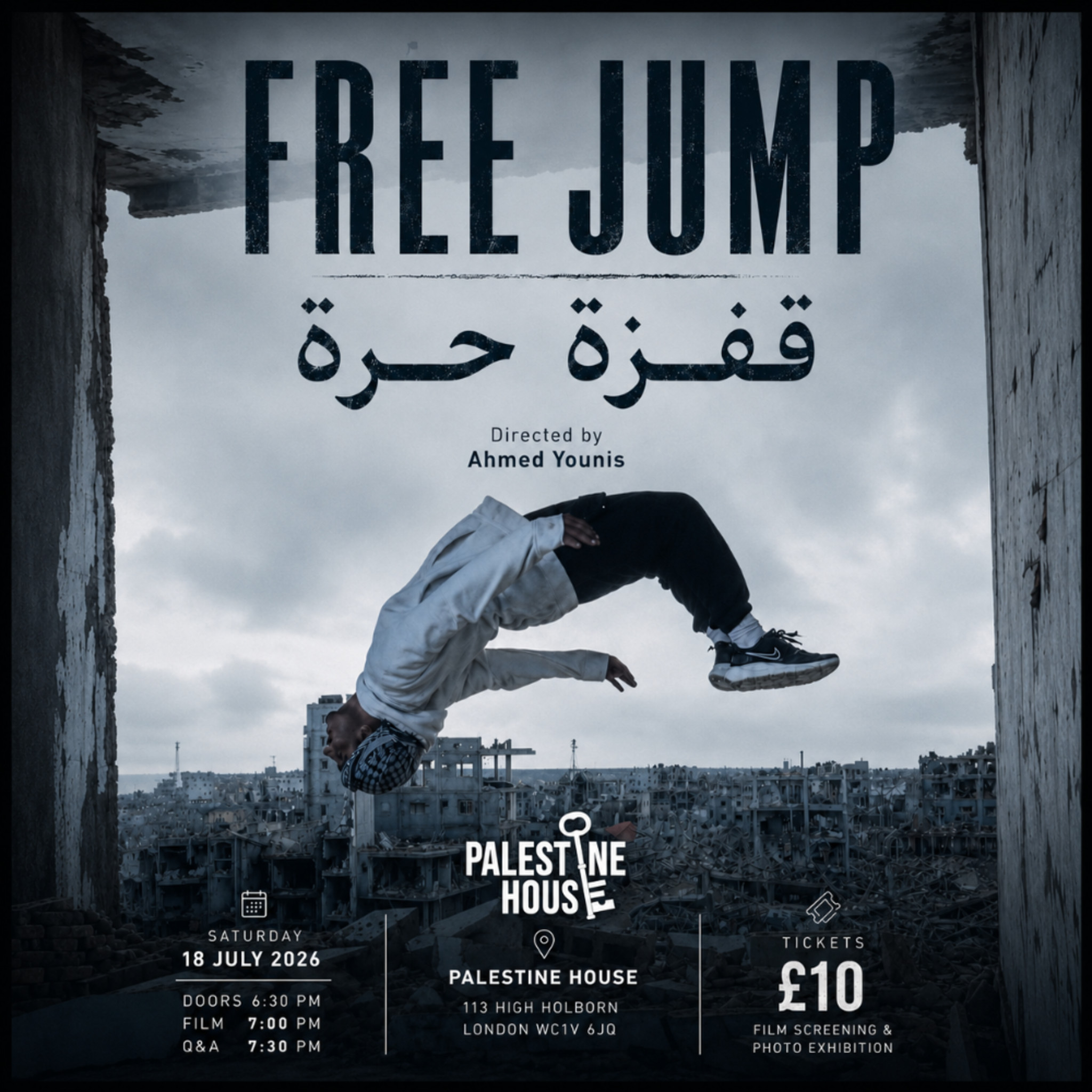
Free Jump follows Ahmed’s friends, a parkour group, as they move through the ruins of Gaza, a portrait of youth, movement, and defiance that many will recognise from clips shared widely across social media. This screening marks the film’s first ever public showing, with further screenings to follow across the UK, Switzerland, USA, and beyond.
As coverage of Gaza continues to be shaped by Western media, institutions, and even Western influencers and content creators reporting from a distance, it is imperative that we prioritise voices from the ground: those actually living this reality, not narrating it from outside. Ahmed’s work, and this film, are part of that necessity.
Alongside the film, a photo exhibition will showcase Ahmed’s work, offering a rare opportunity to see his images beyond the scroll of a timeline.
All proceeds go directly to those featured in the film and towards venue costs. Attendees will also be the first in the UK given access to purchase Ahmed’s prints.
Book of the Week

leena aboutaleb’s debut collection THALASSA is a magnetic mourning, suspended in the threads of eternity. Lush and poignant, THALASSA is a love song of misery and grief, tracing the poet’s steps as she dives into the Underworld in search of her brother. THALASSA is a map of the seen and unseen realms.
‘Like teethbones, I fail to forget you,’ aboutaleb bemoans, ‘I knew you. I knew you.’ Dreamlike, her elegy lights the passage of despair and hope as the poet collapses the ephermal threshold between the dead and the living. Grief is a sea, and leena aboutaleb shows us how to build a boat to find our way home.
THALASSA is out now from Game Over Books.
Media Roundup
Excerpt from THALASSA – Three Poems – Selected poems from leena aboutaleb’s new book THALASSA: “Sweet almond oil, fresh tides of jasmines, rosemary water, crushed hibiscus. The dazzle of dawn, my father gathers a lamb. The bride is made of miracles and sacrifices, as aching and hidden as time’s cycle. I am no one’s beloved. My light stretches the sea, rinsing its salt from banks.”
Standing on the Rubble – Isabella Hammad examines the significance of ruins and rubble in the Arabic literary tradition over nearly a millennium to consider how we should account for the production of ruins and rubble in Gaza today: “As we look upon burned flesh in Gaza, we are also seeing the rubble of this older version of Western empire. How best to splice the frame, to keep them both in mind, to keep looking? How to refuse nostalgia, that basis of violent nationalism; how to grieve, and yet not submit to the romance of the ruin, nor the urge to make permanent what is vanishing?”
The Passive Voice of Light: On Grief and Imperial Grammar – Hanan Habashi, a Palestinian teacher, remembers the sister who taught her the passive voice, and traces the violence of moving through the world as a well-structured argument.
“We Remain”: Music, Survival, and Sumud in Gaza – Ayah Annab argues that musical performances inside and outside of Gaza represent a mode of return that is not physical repatriation, but the resurgence of Palestinian memory and collective struggle.
Hamas Disbanded Its Government in Gaza, but Israel Will Still Prevent Reconstruction From Starting – Although Hamas dissolved its government in Gaza to remove Israel’s pretexts for delaying reconstruction and withdrawal, Tareq S. Hajjaj documents, Israel is now doubling down on a demand for full disarmament as a precondition, a condition designed to be impossible to meet.
The Man Who Walked Toward the "Yellow Line" in Gaza—and the Son He Carried With Him – Mohanad Maher reports on a recent incident where a man underwent a mental break and walked himself and his son into the line of fire near the yellow line in Gaza, subjecting himself and his son to torture at the hands of Israel.
The Ecology of Dispossession – Diana Kruzman argues that Israel’s nature reserves in the West Bank use the language of conservation to restrict Palestinian life while facilitating settlement expansion.
How Israel Uses Sexual Violence as a Tool of Genocide – Nada Elia argues that sexual violence has been central to Israel's settler-colonial project of ethnically cleansing Palestinians since 1948.
Inside the Dispute Over How To Define a Journalist – Christin El-Kholy writes about debates over the redefinition of the category of ‘journalist’ by the Committee to Protect Journalists, which has led to the formal exclusion of some Gazan journalists from the category, highlighting the political pressure that Zionism exerts over Western media institutions.
Egypt, Palestine, and The World Cup: Football’s Political Tradition – Maleeha Haq considers the gestures of solidarity by Hossam Hassan, the coach of the Egyptian national football team, at the World Cup, placing them in a longer tradition of a transnational political tradition in much of the Arab world.
Seeds of War – Marianne Dhenin reports on the food crisis in Lebanon, which Israel has instrumentalized and worsened to make Lebanon both more dependent on foreign imports and thereby less politically and economically stable in the midst of the Israeli siege.
World Cup Short Fiction: Adania Shibli’s ‘A Tin Ball’ – A short story by Adania Shibli on the repurposing of the debris of the occupation into a children’s game of football: “They split up into two teams of three, and began punting the tin back and forth between them. And whenever the tin was kicked too far away, Maya, who was standing on the side too young and too small to know how to play football, would rush to fetch it. It was a truly beautiful day that none of them would easily forget, ever. They were happy.”
Thanks for reading. More next week.
