
Hello and welcome to our weekly dispatch.
Next Sunday marks twenty-six years since the Israeli withdrawal from Lebanon on May 24, 2000, after decades of Israeli occupation of southern Lebanon. The withdrawal was a victory for the Lebanese and Palestinian people against Israel’s impunity and a blow to Israel’s imperial ambitions.
Israel is now attempting to mount another occupation of the south of Lebanon, violating its so-called ceasefire with near-daily bombs and displacing millions of people within Lebanon. This year, then, marks a cyclical return of Israeli expansionism, even as the people of Lebanon remain undefeated and steadfast.
Below is an excerpt from Maya Ayoub’s moving 2024 essay The Sun Rises from the South, written in the wake of Israel’s coordinated pager attack on Lebanon. Ayoub imagines, despite Israel’s vengefulness against the undefeated people of Lebanon and Palestine, a future when the gates between Lebanon and Palestine will be open again.
All the Israelis have are the thousand-pound bombs and ballistic missiles donated by their patrons in Washington; the capacity to obliterate from afar but the inability to hold — in Gaza, Jenin, Nabatieh, Khiam — the land, which falls like sand through their fingers year after year. In the nearly two decades since the Battle of Bint Jbeil, we rebuilt our homes and schools and hospitals; we erected bridges where other bridges once stood; we harvested our tobacco leaves and pressed our olives to oil and we will do it all over again if we have to, if that is the price we must pay to defend the South, to defend our people in Palestine. […]
“Everything between the Litani [River] and Israel must be under the control of the IDF,” said Knesset member MK Avigdor Lieberman in January. What vapid ambition. The Zionists’ hunger for our land exposes the anemic body of their movement. It is a sham that obscures a cold fact: they destroy what they desire; they desire what they can never have. Because we are the rivers, the stones, the trees they seek.
This week in the Dispatch we have:
A new episode of the PalFest Podcast, featuring Tareq Baconi and Saleem Haddad.
The New York launch of Palestine is Everywhere, featuring Mohammed Mhawish and Sarah Aziza.
A call for applications to Dar Jacir’s residency for Palestinian sound artists.
The Third Annual Watermelon Seeds Lit Fest in Vancouver.
Dr. Jamal Salha’s The Survivor: Medicine and Massacre as the Book of the Week.
Your weekly Media Roundup.
New on the PalFest Podcast

How do different forms of writing explore ideas that come from our personal and political histories? In Episode 16 of the PalFest Podcast, Tareq Baconi and Saleem Haddad discuss their new books – Haddad’s novel Floodlines and Baconi’s memoir Fire in Every Direction – with their questions of family, exile, return, and the possibilities of art.
This conversation was recorded at a live event in London on February 11, 2026.
You can watch the video recording on our Youtube channel - and you can listen on select podcast platforms (excluding Spotify). Please consider subscribing and reviewing — it helps our reach a lot.

Upcoming Events
New York: Palestine is everywhere Book Launch with Mohammed Mhawish and Sarah Aziza, 19 May

Join Wendy’s Subway at 7pm on May 19 in celebrating the launch of Palestine is Everywhere, edited by Skye Arundhati Thomas and co-published by Wesleyan University Press and TBA21, with readings by Sarah Aziza and Mohammed Mhawish.
"Palestine is everywhere because it names a political subject of radical universal emancipation," writes teacher and writer Nasser Abourahme. In Palestine is Everywhere, writers, thinkers, poets and artists map the Palestinian struggle for freedom and its global resonances.
Vital dispatches from Gaza, essays, poems, protest chronicles, and images and letters from prison reflect upon resistance, solidarity and the right to self-determination. Amid a world-historical moment marked by unknowability and loss, this collection offers essential reading for those interested in Palestinian liberation.
Edited by Skye Arundhati Thomas, this collection includes contributions from Alaa Abd El-Fattah, Nasser Abourahme, Amal Al-Nakhala, Muhammad Al-Zaqzouq, Maisara Baroud, Ahmed Bassiouny, Houria Bouteldja, Anees Ghanima, Sahar Khalifeh, Laleh Khalili, Lujayn, Lina Meruane, Mohammed Mhawish, Nahil Mohana, Rahul Rao, Nasser Rabah, Adam Rouhana, and Ahmad Zaghmouri.
Call for Applications: OTO Award x Dar Jacir for Art and Research Sound Residency, deadline June 15

For the second consecutive year, Dar Jacir for Art and Research and OTO Sound Museum reunite to amplify Palestinian voices across borders through sound and listening. This opportunity is open to both emerging and established sound artists, providing a platform for their work to resonate with diverse audiences.
The OTO Award is an annual contemporary art prize that recognizes outstanding Palestinian artists exploring and experimenting within the field of sound— artists whose work is conceptually relevant and pushes the boundaries of artistic practices and creative processes.
Contemporary sonic productions are eligible for submission, including pieces that combine sound with other media, computer-based compositions ranging from electroacoustic to experimental music, and sound installations. In addition to the quality of artistic practice, conceptual relevance and originality, the jury will pay close attention to technical and experiential innovation in both form and presentation, as well as the social impact and urgency of the work.
The winner will be selected by a combined jury through an open-call application process and will receive 2,000 Swiss Francs, a digital exhibition at OTO Sound Museum, and technical support and mentorship during the production of their work leading up to the exhibition.
Palestinian artists, regardless of their place of residence, are eligible to apply. If the selected artist is based in Palestine, they will also have the opportunity to participate in Dar Jacir’s Artist-in-Residence program.
Vancouver & Virtual: Watermelon Seeds Lit Fest, 23 May
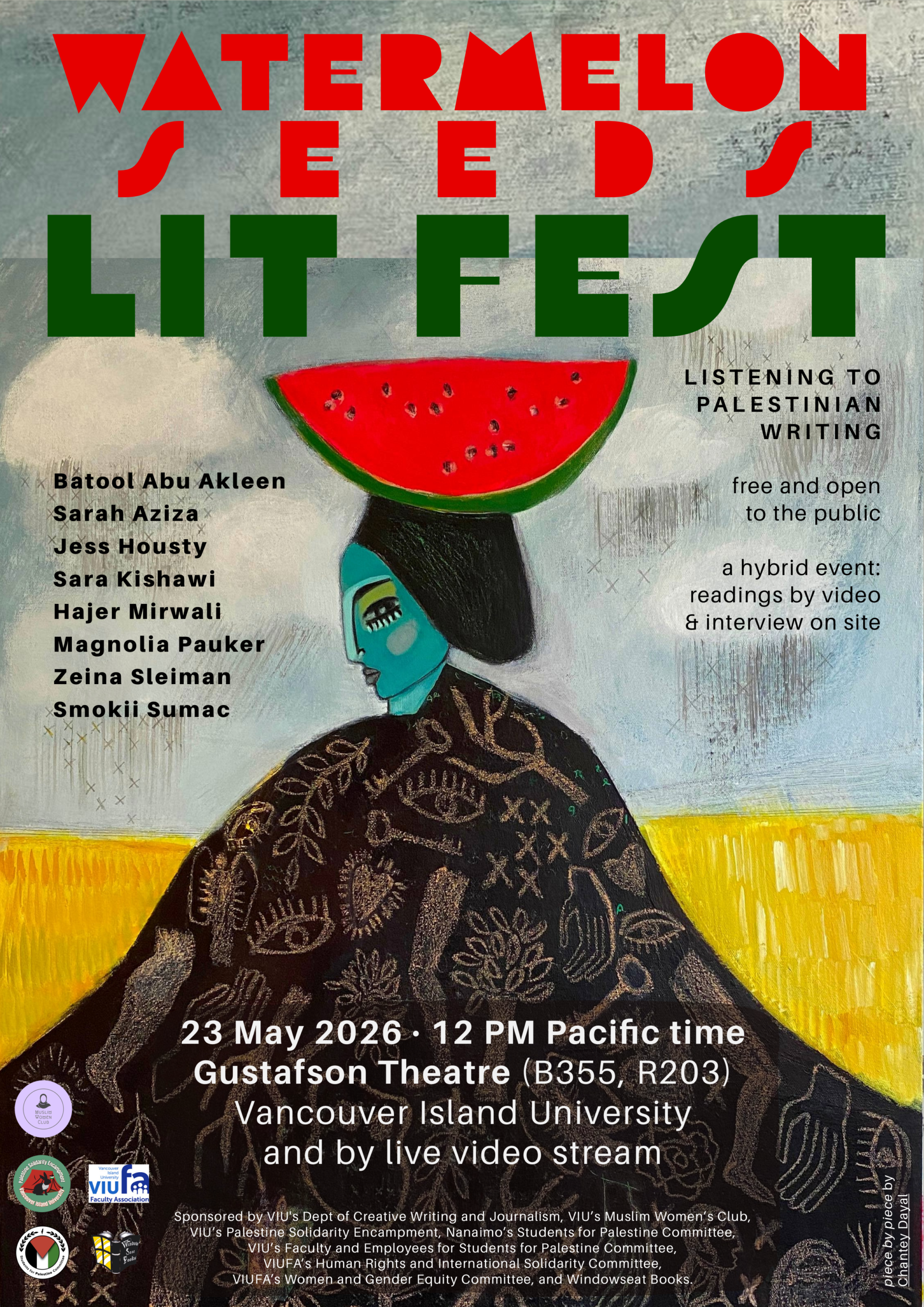
The third annual Watermelon Seeds Festival of Literature commemorates the second anniversary of Vancouver Island University’s Palestine Solidarity Encampment and witnesses the ongoing genocide in Gaza.
Following the success of the second Watermelon Seeds Festivals of Literature, the third annual Festival will take place in the Gustafson Theatre at Vancouver Island University on 23 May 2026, and will also be livestreamed online. The third Festival seeks to foster connections between Indigenous literatures from Palestine and Turtle Island, and to promote intercultural understanding.
The Festival features Batool Abu Akleen (48Kg.), Sarah Aziza (The Hollow Half), Jess Housty (Crushed Wild Mint), Sara Kishawi, Hajer Mirwali (Revolutions), Magnolia Pauker (InterViews in Performance Philosophy), Zeina Sleiman (Where the Jasmine Blooms), and Smokii Sumac (Born Sacred).
Support This Newsletter With a Click
If you’d like to help us keep publishing this free newsletter then please click on the link below from the Audubon Society. You don’t need to do anything else, just click.
It’s genuinely helpful and they pay a quite staggering $1.50 for every time a reader clicks. If 3% of our audience clicked we’d have our budget covered!
ADVERTISEMENT:
Protection for Birds, a Gift for You

Rufous Hummingbird. Photo: Walter Nussbaumer/Audubon Photography Awards
The National Audubon Society protects birds and the places they need, thanks to generous supporters.
Start an annual gift today to help create a brighter future for the birds you love. As our thanks, we’ll send you our quarterly, award-winning magazine.
ADVERTISEMENT ENDS.
And now back to the newsletter and this week’s
Book of the Week

The Survivor is a powerful firsthand account from Dr. Jamal M. Salha, a young physician who volunteered in Gaza’s hospitals during one of the most devastating genocides in recent history. In this deeply personal memoir, he documents nearly 470 days spent inside overwhelmed hospitals, where doctors struggled to save lives amid relentless bombings, collapsing infrastructure, and severe shortages of medicine, electricity, and basic medical supplies.
Through vivid stories from emergency rooms and operating theaters, Dr. Salha reveals what it means to practice medicine under unimaginable conditions. From performing life-saving surgeries with improvised tools to treating waves of wounded patients with limited resources, he bears witness to the resilience of medical workers and civilians alike. Alongside the suffering, the book also captures moments of humanity, courage, and hope that persisted even in the darkest circumstances.
More than a memoir, The Survivor is a testimony and historical record—an unfiltered account of life inside Gaza’s hospitals and the extraordinary determination of those who refused to stop saving lives, even while their own lives were constantly at risk. It is a story of survival, sacrifice, and the enduring strength of the human spirit.
The Survivor is out now - you can get your copy here.

Issue 005 of our new magazine, The Key, is still free to read, featuring a profile of the newly built Phoenix Library in Gaza, analysis of the Israeli wellness industry’s seemingly comfortable relationship with genocide, and an Arabic translation of Alaa Alqaisi’s The Contrapuntal Body - her reflection on exile from Gaza to Dublin.
We’re experimenting with a new model of publishing: free on release, then paywalled after two weeks when the new issue is published.0
Issue 006 will be published on Wednesday, so if you’re a free subscriber then do your reading today!
The growing archive is then fully available to subscribers from $2 a month.
Media Roundup
The Loneliness of the Spared – Haya Abu Shammala describes the discordant feeling of having been away from Gaza since the beginning of the genocide, while her family remains there: “Their vocabulary has grown not through culture or time, but through relentless deprivation: words invented for hunger without end, for healing sought in the absence of medicine. They speak of time that no longer unfolds but circles itself. They speak of places that have been plucked out of geography, stripped of their former innocence and recast as military coordinates and mass graves.”
78 Years Since the Nakba – A special dossier from the Institute for Palestine Studies featuring five newly-translated testimonies by Nakba survivors first published in the Arabic-language journal Majallat al-Dirasat al-Filastiniyya in 1998.
The Document – A new poem by Noor Hindi on what documents translate and mistranslate: “I can’t tell you about Palestine / I’ve never been but I have my Father’s Documents to prove us / The documents that rename me / refuse me / spectacle our birth & our death The Document as map as fiction as shame as eviction.”
Letter to Fadwa Tuqan – A new poem by Safa Khatib in honor of the Palestinian poet Fadwa Tuqan: “your poems / keep the record of the nightmare, / which I once called a future.”
Right of Return – Salman Abu Sitta recollects his memories of the Nakba, noting how little of historic Palestine is actually physically inhabited by Jews, and how much of it was depopulated nonetheless.
The Families of Gaza: Sumud as Collective Endurance – Abdalrahman Kittana theorizes sumud as a decolonial framework for understanding Palestinian victimhood but for comprehending the “historically situated, relational, and materially conditioned practice of collective endurance that emerges, shifts, and persists within ongoing colonial violence.”
I Was There During Nakba. It Didn't Start in 1948 – Ghada Karmi argues that understanding 1948 as the originary moment of the Nakba cedes too much legitimacy to the foundation of the Israeli state, and erases the modes of displacement, ethnic cleansing, and dispossession that had begun decades earlier.
Rafah, My Own Nakba – Hassan Herzallah writes about the cognitive dissonance of encountering descriptions of his hometown, Rafah, in the past tense.
Gaza Elders Who Survived the Nakba Reflect on Being Displaced by Israel Again, 78 Years Later – Mohamed Solaimane profiles those elders who fled from ‘48 Palestine to Gaza during the Nakba to understand how they imagine the genocide in Gaza; as one who says, “This Nakba is more terrifying, more deadly, more destructive. The same form of displacement, the same hunger and thirst and fear — but multiplied many times over.”
A War Over Time – Considering the parallels between the dispossession of Indigenous people in North America and the genocide & ethnic cleansing of Palestine, Maya Mikdashi argues that settler colonies aim to control time in order to “settle” history.
Bassem Khandaqji's Mask is a novel of Palestinian Resistance – Francesca Vawdrey reviews Bassem Khandaqji’s award-winning novel A Mask the Colour of the Sky, describing it as a “literary excavation of the Palestinian past that writes against the logic of erasure at the heart of the Israeli state.”
Criminal Governance – Eliyahu Freedman interviews political scientist As’ad Ghanem who argues that the rise of crime in Palestinian communities inside Israel is not a policy failure, but the result of decades of state efforts to weaken Palestinian collective life.
The Meaning of Palestine to This Levantine: A Matter of Love, a Question of Justice – Amal Ghandour considers how and why Palestine has come to signify so much for Arabs from the rest of the Levant: “To miss Palestine is to miss one’s lost father or mother, sister or brother.”
With No Equipment Allowed Into Gaza, Palestinians Are Digging With Their Hands to Retrieve the Dead – Mohammed Ahmed reports on the ongoing efforts to exhume the dead, still buried under mountains of rubble, and the obstacles that Israel’s blockade has had on getting the necessary equipment and tools to recover and identify them.
Labour’s Gaza Reckoning – Dan Iley-Williamson suggests that the Labour Party’s poor performance in recent local elections attests to the gravitational pull that the Palestine solidarity movement has had on UK politics.
Two New Poems by Marah Muhammad Al-Khatib – Two poems by Gazan poet Marah Muhammad Al-Khatib, translated into English by Ibtihal Mahmood: “Alone / on a balcony with no air / I suffocate, grow intoxicated / Coffee cups multiply / stained with lipstick, overflowing with disappointment / taking me to a fresh bout of insomnia / and thoughts, buried before they could ever see the light.”
The Land Gave Birth – A new poem by Ahmad Ibsais: “It would be enough for me to die, here, on her soil, / Be buried deep in the earth of my country, / Only to sprout forth again as a bright bloom, / Waved gently by a child who calls this land home.”
That’s it from us. Until next week.
You’ve come to the end of the weekly newsletter, so you must kind of like it? You can help us keep publishing it by giving this advert from CBDistillery a click! Thanks.
ADVERTISEMENT:
The New Trick to Reducing Stress Without Losing Focus

Trapped in the cycle of workplace burnout making it hard to focus, leading to more stress? You need CBDistillery’s new Daytime Calm gummies. With 50mg of CBG, shown to increase focus and reduce stress, each gummy is formulated for daytime focus and stress support – and code COOL saves you 25%.
ADVERTISEMENT ENDS
OK now that really is it now. Look out for Issue 006 of The Key on Wednesday.
