
Hello and welcome to our weekly dispatch.
This coming Friday is May 15: Nakba Day. Nakba Day commemorates 78 years since the 1948 ethnic cleansing of Palestine and the establishment of the state of Israel. If these past 78 years signify the ongoing catastrophe in Palestine, they also serve as the measure of an ongoing refusal. Palestinians refuse to be defeated by the colonial project and the world that makes it possible; Palestinians refuse to abide by the rules and norms of the apartheid state; Palestinians refuse, every day for the past 78 years, to give up their rightful claims to the land of Palestine.
Here is an excerpt from Tawfiq Zayyad’s poem We Shall Remain (هنا باقون), written in remembrance of the massacres perpetrated by Zionist militias in the villages of Lydda and Ramlah in 1948. The excerpt below was translated by Nasser Aruri and Edmund Ghareeb for the seminal 1970 collection Enemy of the Sun: Poetry of Palestinian Resistance:
Here, we shall remain.
You may drink the sea;
We shall guard the shade
Of the olive tree and the fig,
Planting ideas
Like the yeast in the dough.
The coldness of ice is in our nerves
And a burning hell in our hearts.
We squeeze the rock
To quench our thirst
And if we starve
We eat the dirt
And never depart
Or grudge our blood.
Here—we have a past
⠀⠀⠀⠀⠀⠀⠀⠀⠀⠀⠀a present
⠀⠀⠀⠀⠀⠀⠀⠀⠀⠀⠀and a future.
Our roots are entrenched
Deep in the earth.
Like twenty impossibles
We shall remain.
Let the oppressor review his account
Before the turn of the wheel.
For every action there is a reaction:
Read what is written in the Book.
Like twenty impossibles
We shall remain—in Lydda, in Ramlah
⠀⠀⠀⠀⠀⠀⠀⠀⠀⠀and Galilee.
This week in the newsletter we have:
An event tonight in New York, featuring Mohammed El-Kurd and Nan Goldin
The Ramallah launch of Ahmad Al-Bazz’s The Erasure of Palestine
An exhibition in London connecting South African anti-apartheid struggles with Palestine
A coming-of-age performance by Palestinian comedian Joe Haddad in London
Paul Aziz Zarou’s Arab American Blues as the Book of the Week
Your weekly Media Roundup
Upcoming Events
New York: Speech Acts: Censorship, Palestine, and the Cultural Front, May 11 (tonight!)
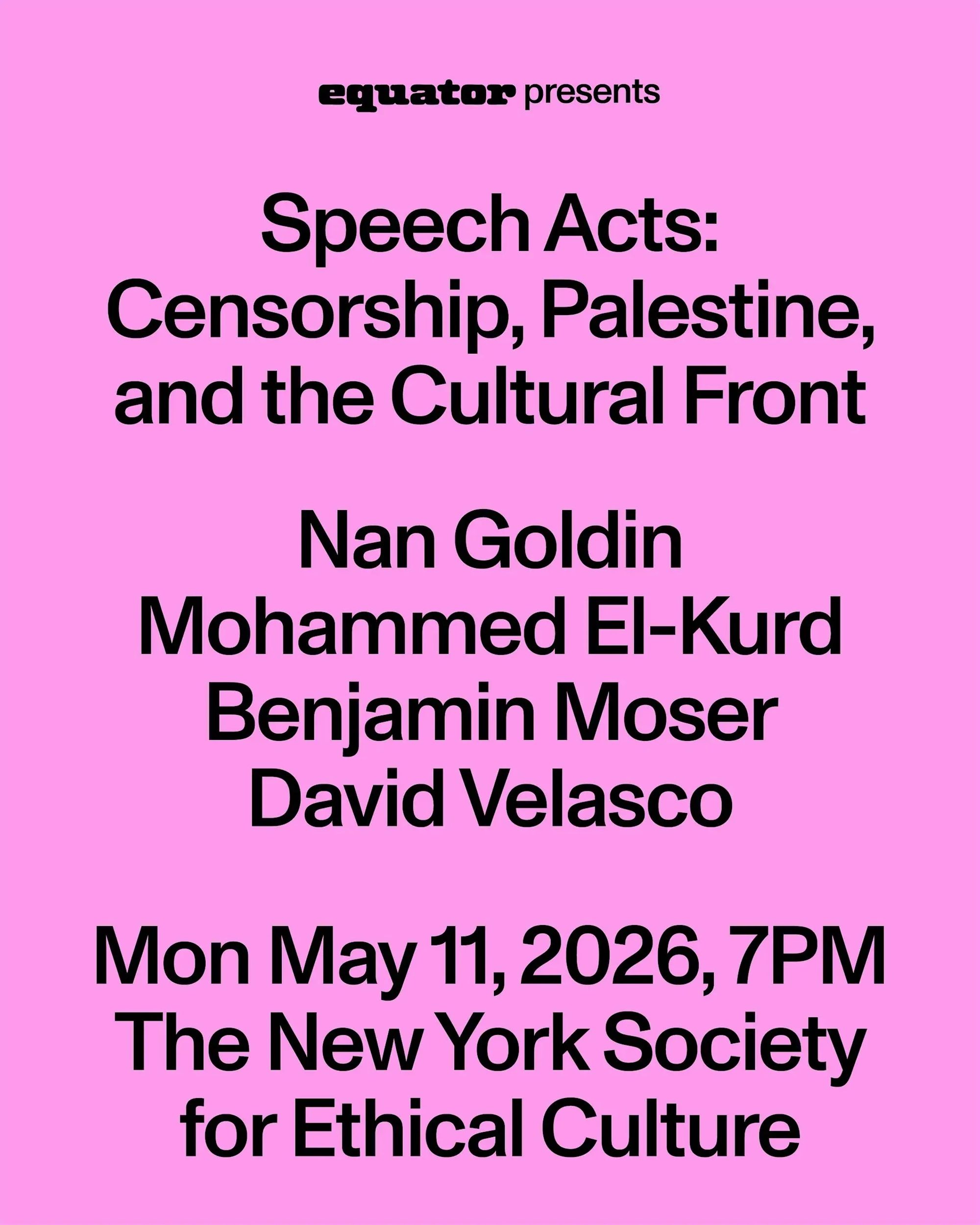
Equator Magazine presents Speech Acts: Censorship, Palestine, and the Cultural Front. Four artists and writers – Mohammed El-Kurd, Nan Goldin, Benjamin Moser, and David Velasco – respond to the narrowing space for public discourse around Palestine.
The conversation will be preceded by a screening of Goldin and David Sherman's short film, Gaza (2025).
There are still a few tickets left, so reserve yours here.
Ramallah: Book Launch, Ahmad Al-Bazz’s The Erasure of Palestine, May 13th

The Khalil Sakakini Cultural Center will host the launch of the Arabic edition of Ahmad Al-Bazz’s careful photographic documentation of the physical erasure, transformation and degradation of the land of Palestine.
Each photograph in The Erasure of Palestine is a precisely framed narrative story containing multiple layers of history.

From the author’s Instagram: Remains of the depopulated village of Qira, near Haifa, are seen in front of the Israeli settlement of Yokne'am Illit (Palestine 2022).

The remains of Bayyarat Hannun with the Netanya stadium behind.
It is a beautiful, subtle, painful book.
Full details of Wednesday’s launch in Ramallah are here.
You can order a copy direct from the publisher here.
London: All Shall Be Afforded Dignity! on view through 27 May
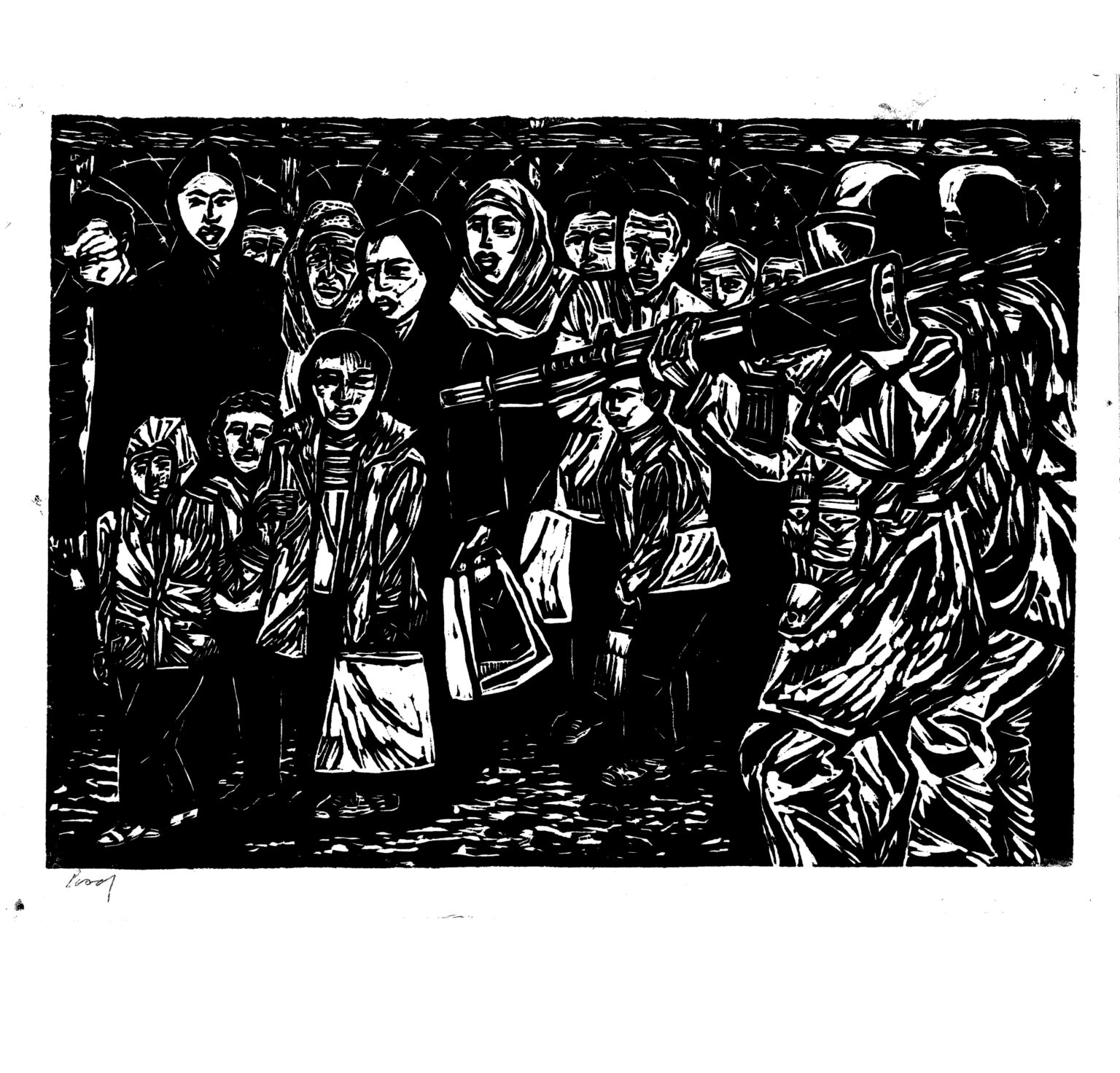
‘All Shall Be Afforded Dignity!’ is curated around the work (of the same name) that artist Norman Kaplan made in 1996 in response to a call for art to celebrate the Constitution of the new democratic South Africa. For the first time in this iteration of ‘All Shall Be Afforded Dignity!’, a selection of Norman Kaplan’s recent linocuts is presented publicly. These new works turn to Palestinian land and people, foregrounding the realities of colonial dispossession alongside expressions of determination and resilience.
Norman Kaplan’s linocuts and prints speak to what life was like under the apartheid regime and remind us of the enduring relationship between art and protest. This display of artwork commemorates the journey to democracy in South Africa, affirming the fundamental human right to dignity for all.
‘All Shall Be Afforded Dignity!’ is presented by The Anti-Apartheid Legacy: Centre of Memory and Learning. The exhibition is on display at Worldly Wicked & Wise near Queen’s Park in London, now through 27 May.

Support PalFest & The Key
Welcome to our new subscribers who recently signed up to The Key, PalFest’s new magazine.
We just published Issue 005, featuring a profile of the newly built Phoenix Library in Gaza, analysis of the Israeli wellness industry’s seemingly comfortable relationship with genocide, and an Arabic translation of Alaa Alqaisi’s The Contrapuntal Body - her reflection on exile from Gaza to Dublin.
These are all newly commissioned works. We are committed both to paying writers fairly and making pieces available for free for the first two weeks on publication - so do please join us as a paid subscriber if you want to help make this possible.
We’ve organised a range of compelling extras as a thank you, which you can see here:
London: PalesTEENian: A Performance by Joe Haddad, 18-19 May

PalesTEENian is a coming of age semi-autobiographical solo show about aspiring comedian and Chelsea Fan ‘Joe’ growing up Palestinian in South London.
PalesTEENian explores identity, culture, belonging and Palestine, but where humour is at the core. With the confusion that arises being part of the diaspora of a country that was never on the classroom globe, to hiding and finding who he is through comedy, Joe finds himself on the brink of stardom. But silently battling the heartache and helplessness of watching a livestreamed genocide in Palestine, whilst questioning his own existence, will he be able to succeed?
PalesTEENian is part of the Peckham Fringe Festival at Theatre Peckham. Find out more and reserve your tickets here.
Book of the Week

A thoughtful coming-of-age story set during one of the most tumultuous and divisive periods in US history.
A lyrical coming-of-age novel set against the political upheaval and cultural reckoning of 1960s America, Arab American Blues explores immigrant identity, race, love, and awakening during one of the most divisive eras in US history. Michael Haddad, the teenage son of Palestinian immigrants, grows up in his family’s working-class New York City grocery store, delivering food through a changing neighborhood in 1967.
As he enters the private worlds of his customers, Michael bears witness to the fractures and solidarities of urban America—from violent encounters with racist bullies to moments of unexpected compassion. He mourns alongside a grieving mother whose son was killed in the Vietnam War, and finds community with the first Black family to move onto the block. Michael’s emotional and sexual awakening unfolds through a relationship with a radical college activist, who introduces him to love, protest, and political consciousness, challenging him to test America’s ideals against its realities. His journey is shaped by seismic national events, including the assassinations of Martin Luther King Jr. and Robert F. Kennedy, which mirror his own inner turmoil.
As racism, social unrest, and generational expectations collide, Michael must confront a sudden personal tragedy and reckon with what it means to be a dutiful son, an Arab American, and an individual seeking freedom. Ultimately, he must face his fears, embrace his heritage, and claim his place in a rapidly changing nation.
Arab American Blues is out now from Interlink Books.
Thank you to everyone that clicked on last week’s advert, it is genuinely helpful.
If you’d like to help us keep publishing this free newsletter then please click on the link below from 1440 News. You don’t need to sign up, all it takes it the click through and they pay us an actual dollar. Over to you!
ADVERTISEMENT:
Daily news for curious minds.
Be the smartest person in the room. 1440 navigates 100+ sources to deliver a comprehensive, unbiased news roundup — politics, business, culture, and more — in a quick, 5-minute read. Completely free, completely factual.
ADVERTISEMENT ENDS.
And now back to the newsletter and this week’s
Media Roundup
Farming Under Occupation in the West Bank – A photo essay by Fredrick Horn, featuring poetry by Gazan poet Yahya Al Hamarna, about Palestinians’ insistent planting and cultivation of the land: “There / A tree still holds my grandfather Mustafa’s name / Since the year he left / Without closing the door behind him. And still / It extends its shade a little further each year / As if making space / For his returning step.”
Remembering Refaat Alareer Through His Students – Zeina Nassar measures the legacy of Refaat Alareer through the project We Are Not Numbers, a platform for emerging Palestinian writers which he co-founded and which continues to afford dozens of writers not just the permission but the opportunity to narrate.
Are Gaza Anti-Blockade Flotillas Futile? – Adnan Hmidan considers arguments that the Gaza solidarity flotillas aiming to break the siege are merely symbolic and therefore futile, positing that stopping these efforts would mean ceding political and psychic victory to the Israeli blockade: “The absence of action would not represent neutrality. It would represent acceptance.”
‘The South, The Last Day’: A Poem for Amal Khalil – A poem by Abbas Beydoun, translated by Yasmine Khayyat, honoring the Lebanese journalist Amal Khalil, who was martyred by Israel last month: “You are the orphan of the mountain and of time / The orphan of your heart, the sky, your beauty / It was your adornment, your sign / With it, you greet ruin / And host the rubble.”
‘Welcome to Hell:’ On Mohammad Sabaaneh’s Latest Graphic Novel – Nada Hodali reviews Welcome to Hell, the latest graphic novel by Mohammad Sabaaneh, a disciple of Naji Al-Ali, which follows multiple perspectives of people trying to move through Gaza under Israel’s genocidal siege.
Could Spain’s Tough Line on Israel Be Contagious Across Europe? – Luciano Zaccara suggests that although Spain is pursuing increasingly pro-Palestinian policies domestically, these will probably have little short-term impact on other European countries or on the EU as a whole.
New $270 Million Israeli-Only Roads Project in the West Bank Is Netanyahu’s Latest Bid to Impose De Facto Annexation – Qassam Muaddi argues that the new roads connecting illegal Israeli settlements are not just part of Netanyahu’s electoral campaign promises, but an attempt to further isolate and fragment Palestinian communities in case of an eventual “international decision imposing some form of Palestinian statehood or independence.”
Settlers as Invasive Species – Maura Finkelstein considers how rodent and insect infestations are not merely natural disasters but means through which Israel has “weaponized a multi-species world.”
Israel Kills Son of Hamas Leader Khalil al-Hayya as It Pushes Maximalist Demands in Gaza Talks – Abdel Qader Sabbah, Sharif Abdel Kouddous, and Jawa Ahmad report on a wave of Israeli airstrikes in Gaza City in yet another violation of the October 2025 ceasefire agreement.
On Palestine 36 and the Ethics of Collective Loss – Aya Nimer reflects on the themes of grief that limn Annemarie Jacir’s new film Palestine 36, considering how mourning serves in the film, as in life, as a “grammar of existence.”
The Soundscape of Genocide – Ahmad Sbaih describes how the genocide has sharpened his hearing and altered the soundscape of Gaza.
The MERIP Podcast Episode 22: Aslı Bâli and Darryl Li – James Ryan speaks to Aslı Bâli and Darryl Li about Palestine organizing in higher education, modes of repression on university campuses, and avenues for legal action to protect Palestine solidarity work by students and faculty.
"The Zionist Project Is What It Has Always Been" – A new episode of the Makdisi Street podcast featuring Jehad Abusalim for a discussion of how isolated life was in the Gaza Strip before the genocide, how the genocide has shredded the social fabric, and what possible futures exist for Gaza in the face of global inaction.
Gaza's Painful Journeys – Qasem Waleed El-Farra writes about how difficult it is to travel around Gaza, owing to the scarcity of fuel because of the Israeli blockade, the destruction of 70-80 percent of vehicles in Gaza by Israeli bombs, the sixty million tons of debris obstructing travel, the decimated road infrastructure, and the high prices that these conditions produce.
Spring in St. Paul – A new poem by Tarik Dobbs on the cognitive dissonance of life in the United States: “Not yet sunset, / the porches keep / their broad hips / turned toward evening, / as if the world / were not daily / teaching itself / new verbs / for taking.”
That’s it from us. Until next week.
